Sunday, 11 October 2015

#Quaxing Lyrical : Part 2

So, at the beginning of the summer, I got myself a trailer for my bike. I posted about my initial experiences here. In this post, I want to give some wider views and what the implications for designing for cycling might be.
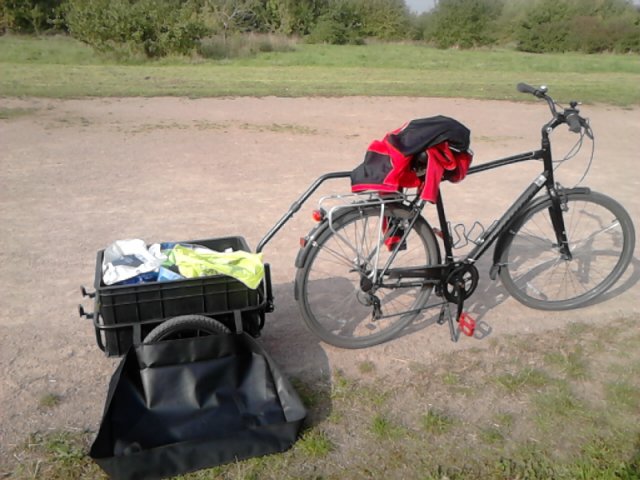
So, as a recap, I have a cheap Veelar trailer  which consists of a steel frame which holds a crate and has an arm which fits to a ball joint attached to the seat stem (like a caravan). 

The width between the trailer wheels is 650mm and the distance from the rear of the trainer to the end of the arm is 1.45m. The box itself is about 450mm wide and 650mm long.

My bike is 1.85m long and the handle bars are 700mm wide which I will return to later. The trailer arm connects 550mm from the rear of the bike which means the whole assembly is 2.75m long and articulates 1.3m from the front. In terms of handling, this is like a mini-articulated lorry!

I also want to bring in a bonus bit of cargo-biking in the form of this rather splendid Christiana tricycle which I rode at the recent London Kiddical Mass event (and which I really enjoyed riding). This bike is about 2.1m in length and 870mm in width. In terms of handling, the steering works by pushing a bar away from you; push left to turn right, but not too far at higher speeds! I didn't try, but the rear seating position means that it would be very difficult to push a button at a crossing and so setting these back really has to be something we work on in this country (or improving detection which would be even better). There are parallels here for wheelchair and mobility scooter users.

The reason for giving these dimensions is to try and explain that if we are to provide for inclusive cycling, then we need to realise that there are bikes out there which have more two-wheels and are not bicycle-shaped. We need to realise that there are people who cannot turn on a six-pence, cannot bunny-hop up and down kerbs and cannot get of their cycles to lift them up a kerb or walk along with them. And steps, well, don't even go there.

Thinking of turning circles, I did perform a complete U-turn on the Christiana on the Outer Circle of Regent's Park, which means an outside radius about about 5.5m; and it was a comfortable and easy turn. In my own street with the trailer, I can easily make a U-turn in its 6m width (a 3m outside radius). The official advice on this is given in Table 2.4 of Local Transport Note 2/08;


So, for my bike and trailer combination (spot-on at 2.75m long), the advice is already tight at just over 2m, although this is a minimum (but really too tight in my view). There is no advice for cargo-bikes, but the guidance is 7 years old, so I am not surprised. Please don't take this table as an endorsement of LTN 2/08, much of the document is dire. On "non-standard cycles", the advice states;

"Most non­-standard cycles are bigger than the conventional bicycle and have larger turning circles. They are therefore unable to be used on facilities designed to the minimum dimensions required to accommodate a standard bicycle. Most access controls for off-carriageway paths do not allow non­-standard cycles through"

The image on the left is the kind of thing you see everywhere, tight
turns which are not going to be easy (or possible) for all. The image
on the right allows the turn to be completed before one crosses the
road. If a Toucan, then you might now have a chance of reaching the
push-buttons from a "non standard" cycle or mobility scooter.
To be fair, the guidance suggests that the minimum inner kerb radius on a cycle route radius should be 4m, although this is not really about cycle junctions, it is about turns more generally. The problem is that much tighter turns are used all the time and they are just not accessible to all

Think about cycling along a a 3m shared-use cycle track and then turning to use a Toucan crossing - where's the 4m minimum inside radius? What this shows is our continued bolting on of cycling infrastructure on layouts designed for other modes will not be accessible to all. If we turn this on its head and make things accessible for all, then the infrastructure is just so nice to use. The London Cycling Design Standards recognises this (p8), but admits that more research is required - well, if anyone is up for it, let's get all of these cycles to a big square of tarmac and play around with some cones; then someone clever can build is an "inclusive cycle" in Autotrack and we can then test out layouts properly before we build them!

The "access controls" mentioned above, are bollards, barriers and gates, which in many cases, means that unless you are on a "standard cycle", you are going to struggle to get through at best; but more often you will be excluded. 

Having to make tight reverse turns (i.e. swing one way and then the other) is pretty much impossible at speed and this is why staggered barriers are used to slow cyclists down (and yes, I have used them for this, although these ones just pass my trailer test). You can get away with it if you think about a path of about 2.5m wide with minimum inside turn radii of 4m, although it makes barriers useless for stopping motorcycles and so to stop cars, you may as well use bollards at 1.8 centres! 

Reverse curves are also forced on one with staggered crossings and assuming you can get your non-standard bike onto them, life is made all the harder in steering around. If crossings have to be in two stages, then they need to be arranged without a stagger and an island of a decent depth (at least 4m in my view). The photo to the left does this quite well, although the turns are tight to and from the cycle tracks either side.

The other things which I have learnt by my trailer (as if I didn't already know) is that smooth riding surfaces are everything, dropped kerbs have to be flush (but you knew that) and cycle gaps need to be wide. There is a huge difference between cycling on machine and hand-laid surfacing anyway, but the bumps of the hand-laid surface bounce a heavily-loaded trailer around which really does affect handling and dropped kerbs which are badly laid are even worse than usual.

For cycle bypasses to pinch points, gaps between bollards and the sea of street furniture, there needs to be clear space of at least 1.5m as you have to thing about catching your trailer wheels. In a straight line, the trailer will follow anywhere the handlebars get through, but of course, handlebars can overhang kerbs and bollards. Having to slalom the little articulated vehicle is another matter as the trailer does not follow the same path!

I have had fun with my little trailer over the last few weeks and it has enabled me to replace a few more car journeys, including fruit foraging which was not accessible by a car and too far to walk laden down with apples. 

Mixing with motors has been less fun, however, as many drivers do not seem to know how to behave around me; so they didn't. Because of the worry about catching the nearside trailer wheels on the kerb, I have been out even further then normal and where there are cycle lanes, the trailer's offside wheels have been outside of the lines. Perhaps these drivers cannot accept that any part of my bike could be outside and they pass the lane as normal which felt worse being further out.

Still, as I often say, there is a learning experience in everything, and my summer travels have given me new insights into the space and dynamic envelopes (the overall space one moves within) needed by cycles. Designers need to do more than ride bicycles, they need to try cycles more generally! Oh, and the brief use of the cargo-bike has left me wanting a cargo-bike! Happy quaxing.

Saturday, 3 October 2015

The Cycle Of Acceptance

I have been force-fed all kinds of management and business models over the years as I have been gently sheep-dipped through never ending corporate training courses. It seems that something has stuck as I was thinking about the five stages of grief this week.

I'll pause there for a moment as the model proposed by Elizabeth Kübler-Ross is about a serious issue and I don't want to make light of it, but with some of the reactions to public consultations over the years and some of the anti-cycling infrastructure news stories, I really think there are some parallels to be explored here. My adaption of the model is a bit flippant of course, but I think there is something in it which is worth the discussion.

I have been thinking about this particularly as a large bridge is about to be rebuilt on my patch (not one of my schemes hasten to add) and a big road will be going from 2 lanes in each direction to 1 lane in each direction for several months.

So, the model says that there are 5 stages of grief; denial, anger, bargaining, depression and acceptance. Thinking about the local bridge rebuild, there have been hints of the first three stages from stuff I have read locally, with the current "bargaining" being about some full closure dates over Christmas for some heavy kit to be moved about; locals are wondering if things can be changed around and what the options are. For this scheme, the decisions are all made and very soon, people will have to accept it, although I am not quite sure what their depression will look like; perhaps being stuck in traffic jams.

So, here is my suggested adaption of the model when applied to cycling schemes (although it could equally apply to anything, such as my views on motorway expansion!);

Denial
The subject has a conscious or unconscious refusal to accept that highway space is going to be reallocated to cycling or a street is going to be made comfortable for those wanting to cycle. The subject will typically cite the behaviour of "cyclists" as why things should not change and that roads are for cars. Impact on bus services will come up quite a bit here.

Anger
The subject will be very upset and anger will manifest itself in different ways. The subject may turn up at public meetings and shout down those trying to make rational arguments. They may dismiss facts and data, making statements like "you don't live here" or "no, the data is wrong". The subject will respond to public consultations with liberal use of capitals in emails and letters, they will use the words stupid and idiotic and resort to personally attacking scheme designers and promoters.

Bargaining
The subject will seek to adjust and rationalise their position. They will talk about "compromise" being needed or perhaps even that that the needs of all road users need to be balanced in an attempt to try and get a scheme watered down. Bargaining rarely provides a sustainable solution. Anti-cycling groups may threaten court action or try and frustrate the process in order to get their views accepted by others. Classic examples will be the subject saying that traffic doesn't need filtering out of residential streets because the main roads cannot take the traffic or that 20mph limits won't be enforced and people should be trusted to drive to the conditions.

Depression
The subject is starting to accept that the scheme is going ahead, but remains deeply unhappy. They remain emotionally attached to their opposition and despite the fact that the decision has been made to proceed with the scheme, the subject is experiencing the dual fear that they are right and the world will end, or perhaps more terrifying; that they were utterly wrong and not only will people be enabled to cycle, that the subject will look foolish.

Acceptance
The subject starts to become emotionally detached from the scheme and their earlier fears. By now, the scheme will be up and running and the world continues to turn. The subject will be able to turn their attention to the next scheme, but conveniently forget how well the last one turned out and contradicts their long-held prejudices.

OK, I have poked fun at the expense of a serious subject, but understanding one's opponent is half the battle and at the end of the day, we are all people and we all go through the rollercoaster of emotion and we all find it hard to accept facts if they don't fit with our world view.

Wednesday, 23 September 2015

A Walk In Winchester

Well, this is one of those "what I did last week" posts, but for me, there is always a learning experience to be had. So, last Friday, the car had a rare outing (to be sat) on the motorways and I headed to Winchester.

I was there to give a short presentation for the Chartered Institution of Highways & Transportation's "Walking Group" at the "creating a more walkable Winchester" workshop which was attended by various city councillors, local walking groups and staff from the City and Hampshire County Council. There were also presentations from Living Streets and the County's public health team. The most interesting part of the session (for me) was when we went out in small groups to have a walk around and to discuss the issues we saw.


Winchester is a very compact city with most of the outer residential areas being within a 40 minute walk of the centre (see left from the City's Walking Strategy). From my discussions with the great and the good, it would appear that the area has a high level of car ownership (with many multi-car households) and there are plenty of people who drive in from the surrounds to work and to get to the station. An interesting point is made in the strategy that walking is often quicker than driving!

Despite having three park-and-ride hubs on the outskirts, the place is congested at peak times and still busy during the day. There is lots of public car parking in the city which ranges in price by location. I parked at the Chesil car park which was apparently weird because it involved walking into the city (no more than 5 minutes!) The park-and-ride might have been more sensible, but I didn't have any coins with me to pay for it and I probably should have taken my folder and cycled in (although the motorways were bad and I was pushed for time).


Friarsgate - a one-way traffic sewer.
Noisy and fast (despite the 20mph speed limit)
There is no ring road around Winchester, but it is saddled with an awful one-way system which partially acts as one and it has several main roads arranged radially which really shouldn't be taking the traffic they do. These roads create severance between the outer-residential areas and the city core, as well as being hostile and not at all permeable for cycling.

As we walked around, we discussed the usual "quick wins" of delcuttering, providing decent dropped kerbs and tidying up planting, but it was recognised that substantial change to the infrastructure was needed which is difficult against the backdrop of cuts to local services and with a highway authority in Hampshire County Council which doesn't have quite the same focus on active travel as city councillors and activists would like.

A driver turns right off the right hand lane of the one-way road, on the
wrong side of the road. They weren't the only one. I watched for 5
minutes and all three right turners did the same. It's the layout.

There is an old, but reasonably protected cycle route through this
junction
running left-right. To the right (behind the photo) one could
reach the South Downs National Park which encroaches into the city.
Except the crossings of the M3 are awful.

It has been correctly realised that the city is also an attraction for tourists and so lots of coaches have to be catered for. Sadly, they are catered for in a really wide road outside the Guildhall which is an awful space in front of such a wonderful building. But, it's not all bad. The city core is pedestrianised with some cycle access (it should be the whole core of course), but it attractive, well-maintained and has life, which is what the shopping streets with heavy traffic lacks as people walk through as quickly as they can.


A nice "sticky street" where people want to come and where people
want to stay.

Even the quality of the buskers reflected the quality of the space!

Sadly, I didn't get enough time to walk around further as is often the case with these flying visits and one cannot get a grasp of the issues in a couple of hours. However, I think Winchester is a good example of a typical town (I know it's a city) with the typical tensions of wanting a great place for people to be in, but also so reliant on the car and with the consequences of its domination of the areas around the central core. 

What did impress me is how a cross-party group of politicians have come together with non-political groups to agree that something has to be done and indeed get a strategy in place which is politically-led, rather than leaving it to officers (who supported of course). The more I travel around and meet people, the more I can sense that there is an underlying dissatisfaction with our urban places and a desire for change. Many people don't know how to get change and they don't know how it could be. An interesting point was made by a councillor that people go on holiday to wonderful places where they can walk everywhere, but can't make the link to the places they drive to back home. We have a lot of work to do in the UK.

Saturday, 19 September 2015

London Kidical Mass 2015

Today was rather fun! We had the London Kidical Mass on our calendar for some time and originally it was going to be Ranty Junior and me attempting to get our bikes to Regent's Park.

Presumably, I was calling the Cones Hot Line
He was feeling a little tired (big school does that) and so in the end all 5 of us headed across Town  on the rails with a pair of scooters and the baby with her push along tricycle. 

We arrived right on time to be greeted by Mama Moose (aka Deborah) who proceeded to have a word with Roman of London Green Cycles (LdnGreenCycles) and after a short walk, I was suddenly in charge of a rather large box-bike and so rather than playing catch-up with the wheels and feet we had, we were in the middle of the action (although Mrs RH ended up baby sitting another cargobike and caught up with us later). This was the first time I had ever ridden a cargobike (well apart from using my trailer) and as usual, a different way of riding.

We rode around Regent's Park, people of all types on all sorts of bikes in the Autumn sun. Three kids in a cargobike with huge grins and one big kid doing the pedalling. After the ride, there was a picnic and a chat with some old faces and some new ones. We then took the bike back and had a nose around the shop. The talk as we walked away, was all about bikes and coming back to hire one or two for a family ride. Seriously, we need to keep pushing for the infrastructure and changes to London's streets so everyone can move under their own steam and in safety. So, as usual for this kind of day, I shall leave you with the photos (taken by Ranty Junior).


Saturday, 12 September 2015

It's An Accident Waiting To Happen!

They are the phrases so often seen in the local press; "something must be done before someone is killed" and "it's an accident waiting to happen"; and perhaps, they're a proxy for an underlying dissatisfaction with how our streets are arranged and managed.

Accident is not a word to be used when talking about our streets, simply because it has overtones of randomness, of an incident which simply happened and couldn't be prevented (although unless you have a TARDIS, you are not going to be able to prove prevention). The words to use are collision or crash, the second of which is perhaps getting a little more emotive, but often used emotively with good reason.

Those of us who design highway schemes routinely use casualty data to look at historic trends and to find patterns, but they really are the tip of the iceberg and so we also need to think about risk (plus looking as casualty data is another post in its own right). Road Safety Audit, when used properly, can highlight potential risks during the design and implementation of a scheme or we can simply consider collision risk in that similar types of features are likely to create conditions for similar collisions. So, we have data showing "things which have happened" and can use our experience to look at "things which might happen", but what about the space between, the "things which could have happened"?


Chris Boardman launches the event, talking about our inner chimp!
Fortunately (at least for people on bikes), there are people looking at just this. The Near Miss Project has just published a report on its first year and it makes for some interesting reading. I will leave you to read the detail, although I will pull some things out which I personally find interesting and useful as an engineer. Of course, I am also interested as I took part in the study which collected and analysed 4,000 incidents from a day diary kept by 1,500 volunteers. The day was selected in advance (so no picking the worst day of a week in retrospect), but yes, this type of thing does rely on honesty.

After the official launch which was kicked off by Chris Boardman (yes, that one) with the report highlights given by Dr. Rachel Aldred, those attending split off into group discussions on various topics including engineering and legal issues, plus there was lots of non-structured discussion too. Now, I am from the pro-infrastructure end of the cycling debate as you know (which doesn't mean building cycle tracks on every single road before someone takes issue) and it was interesting to listen to plenty of views which I don't agree with. Interesting, because the views often come as a result of people's experiences and how they cope with the conditions out on the streets. I have seen comments on Twitter suggesting that the report is there to sell segregation or that it dangerises cycling.

It has been said by some that the "near misses" recorded in the study were not real incidents. It may be that those articulating this point are doing so because they either don't recall being exposed to the same kind of thing or see it is happening to those "less experienced" cyclists. Additionally, these "non incidents" are only ever going to be anecdotal; they are only people's experiences and opinions plus, different people would view the same kind of things differently. Well, that is the point isn't it? There was also debate around the so called "safety in numbers" effect (which wasn't found by the research).

We are in relatively new territory here, because we are now asking the end user to provide feedback on the current situation. In the same way as casualty-analysis can show patterns, the use of this kind of data (and location was logged) will start to show patterns of where people feel most exposed.

So, back to the things which interested me especially. Despite this project having those reporting deciding for themselves what was scary or just annoying (with no thresholds), 94% of the reports classified near misses in 5 ways;

  • having the way blocked (38%)
  • a problematic (usually close) pass (29%)
  • a vehicle pulling out/ in (16%)
  • being driven at (6%)
  • left/ right hook (5%)
Having the way blocked is interesting as it is those situations where a cyclist needs to pull out to get round something such as a parked car. This type is issue wasn't considered as being particularly scary, but over time of course, it makes cycling hard work. The scary issues were the other four categories (56% together) although being driven at is not necessarily a driver being aggressive, it can be situations where there is a single lane available because of parked vehicles. The report muses overlaying the data with casualty records to look at other patterns which is a very good idea.

It was suggested that in areas with higher levels of cycling, there was no reduction in the rate of near misses (against the safety in numbers proposition). The project hopes to expand internationally in the future and it would be very interesting to look at near miss frequency in those high cycling places which coincidentally have well-developed and safe provision for cycling.

I visited the Victoria Embankment after the launch. On busy routes
like this, the provision of high-quality infrastructure to keep people
who want to cycle away from vehicles and will provide good levels
of experienced safety.

If you don't want to cycle in places like this, then fine, but this is
designed for people who are scared of riding in heavy traffic and with
heavy vehicles such as this low loader.
The other point which interested me was that the faster people cycle, the less likely they are to report near misses. This conclusion was stripped of demographic issues and so was stated with good confidence. Cyclists how reach their destination at 8mph or less (over the whole journey) have three times more near misses per mile as those travelling at 12mph or faster. To put this into context (with an anecdote!) I had a look at my times for the Ride London 100 (well 86) from last year. For the first 17 miles, I averaged 16 miles per hour which was after a lot of training with an overall average speed of 11 miles per hour. I think my normal pootling speed is 9/10 miles per hour (I don't measure it) and so from the study, I would reckon that those at the 12mph end are most likely to be those who are fitter than me, cycle further, are used to mixing with traffic and are more numb to near misses because of the way in which they cycle as a way of coping with the conditions.

The good news is the study is going to continue and is looking for people to record their experiences towards the end of next month and you can sign up here. Beyond this, it is hoped to go international. What would be amazing is if in some way near misses could be reported, mapped and classified automatically and made open-source, just imagine the possibilities. This type of work is so valuable in understanding experienced safety because we can throw statistics at people about how safe cycling is in absolute injury terms, we can go on about the mode share for a particular area, but it is for nothing if people feel scared.