
So, at the beginning of the summer, I got myself a trailer for my bike. I posted about my initial experiences here. In this post, I want to give some wider views and what the implications for designing for cycling might be.
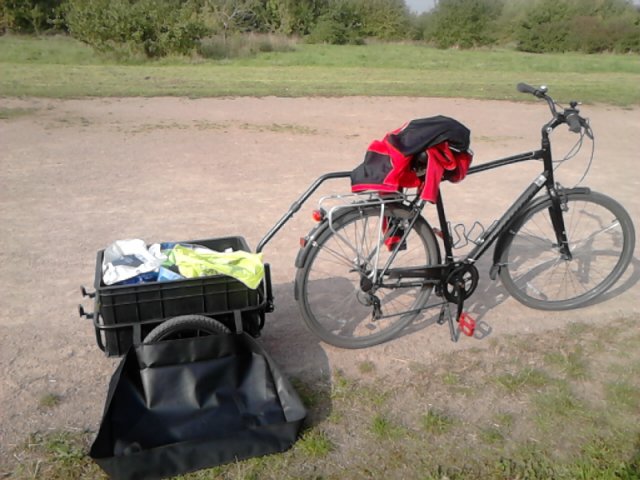
So, as a recap, I have a cheap Veelar trailer which consists of a steel frame which holds a crate and has an arm which fits to a ball joint attached to the seat stem (like a caravan).
The width between the trailer wheels is 650mm and the distance from the rear of the trainer to the end of the arm is 1.45m. The box itself is about 450mm wide and 650mm long.
My bike is 1.85m long and the handle bars are 700mm wide which I will return to later. The trailer arm connects 550mm from the rear of the bike which means the whole assembly is 2.75m long and articulates 1.3m from the front. In terms of handling, this is like a mini-articulated lorry!

I also want to bring in a bonus bit of cargo-biking in the form of this rather splendid Christiana tricycle which I rode at the recent London Kiddical Mass event (and which I really enjoyed riding). This bike is about 2.1m in length and 870mm in width. In terms of handling, the steering works by pushing a bar away from you; push left to turn right, but not too far at higher speeds! I didn't try, but the rear seating position means that it would be very difficult to push a button at a crossing and so setting these back really has to be something we work on in this country (or improving detection which would be even better). There are parallels here for wheelchair and mobility scooter users.
The reason for giving these dimensions is to try and explain that if we are to provide for inclusive cycling, then we need to realise that there are bikes out there which have more two-wheels and are not bicycle-shaped. We need to realise that there are people who cannot turn on a six-pence, cannot bunny-hop up and down kerbs and cannot get of their cycles to lift them up a kerb or walk along with them. And steps, well, don't even go there.
Thinking of turning circles, I did perform a complete U-turn on the Christiana on the Outer Circle of Regent's Park, which means an outside radius about about 5.5m; and it was a comfortable and easy turn. In my own street with the trailer, I can easily make a U-turn in its 6m width (a 3m outside radius). The official advice on this is given in Table 2.4 of Local Transport Note 2/08;

So, for my bike and trailer combination (spot-on at 2.75m long), the advice is already tight at just over 2m, although this is a minimum (but really too tight in my view). There is no advice for cargo-bikes, but the guidance is 7 years old, so I am not surprised. Please don't take this table as an endorsement of LTN 2/08, much of the document is dire. On "non-standard cycles", the advice states;
"Most non-standard cycles are bigger than the conventional bicycle and have larger turning circles. They are therefore unable to be used on facilities designed to the minimum dimensions required to accommodate a standard bicycle. Most access controls for off-carriageway paths do not allow non-standard cycles through"
 |
| The image on the left is the kind of thing you see everywhere, tight turns which are not going to be easy (or possible) for all. The image on the right allows the turn to be completed before one crosses the road. If a Toucan, then you might now have a chance of reaching the push-buttons from a "non standard" cycle or mobility scooter. |
To be fair, the guidance suggests that the minimum inner kerb radius on a cycle route radius should be 4m, although this is not really about cycle junctions, it is about turns more generally. The problem is that much tighter turns are used all the time and they are just not accessible to all
Think about cycling along a a 3m shared-use cycle track and then turning to use a Toucan crossing - where's the 4m minimum inside radius? What this shows is our continued bolting on of cycling infrastructure on layouts designed for other modes will not be accessible to all. If we turn this on its head and make things accessible for all, then the infrastructure is just so nice to use. The London Cycling Design Standards recognises this (p8), but admits that more research is required - well, if anyone is up for it, let's get all of these cycles to a big square of tarmac and play around with some cones; then someone clever can build is an "inclusive cycle" in Autotrack and we can then test out layouts properly before we build them!

The "access controls" mentioned above, are bollards, barriers and gates, which in many cases, means that unless you are on a "standard cycle", you are going to struggle to get through at best; but more often you will be excluded.
Having to make tight reverse turns (i.e. swing one way and then the other) is pretty much impossible at speed and this is why staggered barriers are used to slow cyclists down (and yes, I have used them for this, although these ones just pass my trailer test). You can get away with it if you think about a path of about 2.5m wide with minimum inside turn radii of 4m, although it makes barriers useless for stopping motorcycles and so to stop cars, you may as well use bollards at 1.8 centres!

Reverse curves are also forced on one with staggered crossings and assuming you can get your non-standard bike onto them, life is made all the harder in steering around. If crossings have to be in two stages, then they need to be arranged without a stagger and an island of a decent depth (at least 4m in my view). The photo to the left does this quite well, although the turns are tight to and from the cycle tracks either side.
The other things which I have learnt by my trailer (as if I didn't already know) is that smooth riding surfaces are everything, dropped kerbs have to be flush (but you knew that) and cycle gaps need to be wide. There is a huge difference between cycling on machine and hand-laid surfacing anyway, but the bumps of the hand-laid surface bounce a heavily-loaded trailer around which really does affect handling and dropped kerbs which are badly laid are even worse than usual.
For cycle bypasses to pinch points, gaps between bollards and the sea of street furniture, there needs to be clear space of at least 1.5m as you have to thing about catching your trailer wheels. In a straight line, the trailer will follow anywhere the handlebars get through, but of course, handlebars can overhang kerbs and bollards. Having to slalom the little articulated vehicle is another matter as the trailer does not follow the same path!

I have had fun with my little trailer over the last few weeks and it has enabled me to replace a few more car journeys, including fruit foraging which was not accessible by a car and too far to walk laden down with apples.
Mixing with motors has been less fun, however, as many drivers do not seem to know how to behave around me; so they didn't. Because of the worry about catching the nearside trailer wheels on the kerb, I have been out even further then normal and where there are cycle lanes, the trailer's offside wheels have been outside of the lines. Perhaps these drivers cannot accept that any part of my bike could be outside and they pass the lane as normal which felt worse being further out.
Still, as I often say, there is a learning experience in everything, and my summer travels have given me new insights into the space and dynamic envelopes (the overall space one moves within) needed by cycles. Designers need to do more than ride bicycles, they need to try cycles more generally! Oh, and the brief use of the cargo-bike has left me wanting a cargo-bike! Happy quaxing.


