Saturday, 24 November 2018

School Streets - The Basics

I'll let you into a little secret. Although the idea of 'school streets' seems radical, the legislation allowing us to deliver them has been around for decades.

The term 'school street' is not some kind of legal term, it's a marketing idea designed to win hearts and minds. If that what it takes, then fine, but the mundane fact of the matter is we are using traffic engineering tools to protect children from drivers and rolling out the concept has to be applauded because as ever, it demonstrates that asking people to play nicely doesn't work and that infrastructure is generally the answer.

School streets are essentially just 'pedestrian and cycle zones' which use traffic orders and some of the tools of filtered permeability to create quieter or motor traffic-free streets around schools. As with any scheme, local context is important in tailoring the design for the situation. The basic traffic sign to be aware of is 618.3C of the Traffic Signs Regulations & General Directions 2016 (TSRGD16) and this is used at the entry points to the 'school street';


For a school street, we're not going to need to worry about all of the permutations, but I think the following will be our considerations;

  • The 'pedestrian and cycle zone' wording and the red circle with the motor car and motorcycle is a basic requirement. It means that the way ahead is only for people walking and cycling; and we want the latter because we want kids cycling to school.
  • Next we have the times of operation. This is going to be Monday to Friday for the main part and the times are going to straddle the start and end of the school day. I'll come back to this in a minute.
  • Exceptions can include blue badge holders, loading, permit holders, buses and taxis. Blue badge holders might be exempted, especially is there are pupils being driven to school or a member of school staff needing assistance, although it may be that the member of staff arrives before the restriction starts. We don't want loading or taxi access at all in my view, although bus access might be needed.
  • The "at any time" plate at the bottom essentially explains that beyond the entry point, there is no parking or waiting to take place - in essence it's a signed version of a double yellow line. This can be varied to a part time control and in all cases, repeater signs are needed. If there is a general problem with parking, then this can be a useful (and tidy) addition.
  • Of course, as this operates on a zonal basis, we can include as many streets as we like.
For completeness, for the exit points from the zone, 'zone ends' signs are needed;


Unless the parking controls introduced on the entry sign are being used, it's a kind of pointless sign because if one is not allowed to drive in during the restriction times, then one won't see the sign. If one drives into the zone when it's not operational, then it's academic. However, it might just help reinforce the zonal approach when people notice is and so I'll go with it and as pointed out by @ShowMeASignBryn;

"the Zone Ends sign is important to warn people inside the Zone that they are passing the end of the restricted area and should be aware of "normal" road conditions past the sign especially if the street design is identical."

In terms of keeping people out during the restriction time, there are two main options;

  • Camera enforcement. Using automatic number plate recognition (ANPR), those driving into the zone will be detected and a fine issued by the traffic authority. Fixed cameras can cost £15k-20k each to procure and install and they need power, communications and a 'back office' to process the fine. CCTV cars are the other way to deal with the enforcement and so they could be deployed randomly as part of general tasking.
  • Removable/ foldable bollards or gates can be used to physically prevent motor traffic accessing the zone. This requires somebody to physically deal with the bollards and gates. If the zone has a morning and afternoon restriction, then this means the closure is attended to four times. 

With the physical approach, the easiest way to manage this would be by putting a formal agreement in place with the school, so they can deal with the process. Because we are also probably only going to run such a scheme during term time, it would also make sense to enlist the school's help to change the signs at the start and end of term as well. If we don't do this, then the restriction would apply during the school holidays. This might actually be fine, but if residents or business are affected, then we may want to take them into account during holidays.

The easiest way to manage the signs would be to use a folding sign which can be locked open or closed as required and this could again, be managed by the school by agreement. There are also variable signs that have rotating prisms which do the same job, but it's something else to maintain. Here's an example of a folding sign from a scheme in Hackney;


You can see that the top half of the sign folds down to cover the bottom half and there are toggle locks to hold it in place. In this example, the restriction applies for 45 minutes in the morning and the afternoon and people with the correct permit are exempt (this could be residents or businesses). In fact, Hackney has quite a nice scheme explainer and details on it's website as does Edinburgh.

How such a scheme is established is up to you. A permanent scheme requires the usual public consultation, traffic order and decision-making process. Alternatively, an experimental traffic order could be used which allows a live scheme to be part of the consultation process. Either way, it is likely to need a decent level of public engagement because in essence, we are telling people they cannot drive somewhere.

A permit system perhaps reduces the pain for residents and if their street is usually blocked at school times, they may welcome it. Care needs to be taken that the problems in the streets by the school don't just get pushed a bit further out with unintended results being the issue. However, given that it only takes a few parents to increase the risk exposure to many children, then it's a welcome use of one of our traffic management tools.

If we make driving kids to school harder, some who are making the short trips will give up and walk (or cycle). I acknowledge that some people drop their kids off as part of their journey to work or elsewhere, but that doesn't give them licence to park next to the school or put everyone else at risk. They'll have to change.

Sunday, 18 November 2018

Adoption, Dedication & Use

How do streets, or more specifically - highways, come into existence? Who maintains them? And, what say does the public have? This week's post is a brief run around the law.

By far the easiest way to create a new highway is for it to be built by a developer and for the local highway authority to 'adopt' it by agreement. In other words, the developer (or land owner) and the authority will enter into a legal agreement which will set out various terms and conditions to be met (on both sides) which will lead to the new road/ street being taken over.

The agreement is made under S38 of the Highways Act 1980 and it can be as complicated or as simple as both parties agree. It is usual for specification of the new highway to be agreed (structural design, surfacing, drainage, lighting etc) normally with drawings, inspections of the work being undertaken by the highway authority, the issuing of certificates of completion, maintenance periods etc. 

It can equally be applied to an existing road where the highway authority is satisfied that the quality is good enough for adoption (sometimes intrusive investigation is needed). I should point out that the law in Scotland and Northern Ireland is different, so please forgive me as I simply don't have experience of the process there. There is a Scottish guide here and Northern Ireland guide here.

A 'commuted sum' can form part of the agreement which provides money up front to be invested in future maintenance of the new highway (either ring fenced, or more usually, generally). There will also normally be a cash deposit or bond which the highway authority can access if a developer goes bust and the works need to be completed (which means that any residents moving in don't have to pick up the bill).

Contrary to popular belief, the highway authority doesn't take ownership of the land, just the fabric of the new highway. Put simply, a highway is a legal (and often physical) veneer over land which affords the public to pass and repass (subject to any prevailing restrictions). There is case law on how deep a highway goes into the ground and there is no one answer. It's generally taken as what is necessary and so could be a few metres down to include a sewer (as utilities have highway rights) or it could have no depth at all. A railway tunnel, by contrast,  wouldn't be within the highway, even if shallow. All good fun!

The approach and policy within each highway authority does vary, but the basic processes are similar. S38 is by far the best way to deal with it because the other ways of establishing a highway can often be a complete pain. Highway authorities do not need to adopt anything they don't want and it's difficult to talk about policy in general.

If we take a general approach of something looking like a highway, operating like a highway and being used like a highway, then it is often the case that it is a highway. At least if this has gone on for at least 20 years. S31 of the Highways Act 1980 essentially provides for such a situation, although it's a little more than someone saying "it's a highway".

The problem is that the highway authority doesn't go around looking for things to designate as highways and so this '20 year rule' only ever gets tested if there is a dispute and the highway authority has to adjudicate. In addition, S66 of the Natural Environment and Rural Communities Act 2006 altered the Highways Act to remove the ability of S31 to apply to the use of mechanically-propelled vehicles to establish a 'way', although than a 20 year period starting before 2006 (so it will an obsolete clause by 2026). The term 'mechanically propelled vehicles' does not include pedal cycles and e-assist cycles.

In general terms, the process gets kicked off when a route gets blocked by someone and someone else who has been using it complains to the highway authority - the issue has been called into question and the 20 years will now stem from the date of the complaint. The complainant can then be invited to provide evidence that the route has been open for an uninterrupted period - and that can be difficult for individuals of course.

The local authority can write to frontagers (those with property fronting the way) to try and gain witness statements and of course, there may be historic photographs which can help test the assertion. The final position may well be down to tracking down the actual owner of the land to see if there was any declaration or other evidence that the land was or wasn't intended to be used as a highway. It's often a process which can drag on for a very long time and it's potentially costly unless the evidence is clear cut. Negotiation and agreement is always the easiest way forward.

In order to protect their position, landowners can (and should) lodge a declaration with the highway authority that the 'way' is not intended to become a public highway. They would submit a map and a statement explaining that the way is not intended to become a highway and this information is held 'on deposit' as part of the 'highways register' which is the record of highway information in an area. They can equally decide that the way is to become a highway and submit a declaration to 'dedicate' it as such. It doesn't mean the highway authority undertakes any maintenance, just that the public get a right to use it.

A landowner can also regularly block the route (using gate for example) or erect appropriate signage to explain that the way is not a public right of way. Many landowners don't realise that the law is here and this does lead to tensions where they suddenly close something off which people have been using. My personal view is that highway authorities would be better taking a proactive approach in looking at what is happening in their area and looking to secure routes which serve public amenity as highways.

It doesn't necessarily follow that a highway becomes maintainable 'at public expense', save for the S38 process. A highway exists as a legal veneer over land and there are countless examples where the residents/ frontagers and/ or landowners maintain a highway over which there is full public access. The highway authority can impose restrictions (parking and traffic) over these highways as they would on one maintained by them. 


Above is an image of a road maintained by the residents, but on which the highway authority controls parking. A restricted parking zone has been chosen because it's virtually impossible to paint yellow lines and parking bays on the road which is little more than a track!

There are other (more complicated) processes which I won't cover here as they are a little more obscure, but I will mention S228 of the Highways Act 1980 which is a great wheeze. It's often used when there is no record of a landowner, but the highway authority wants something to become a highway after works are undertaken (by the highway authority) to 'improve' the way. A simple site notice gives a month for people with interest in the land to object, although if there are relevant objections, it could get bogged down in the magistrates court.

S228 can also be used if the landowners are known, but as with above, if there is hostility to the way becoming a highway, then the process is fraught.

I probably shouldn't have to say it, but I'm not a lawyer and as with design issues, you should seek your own independent professional advice. Highway law can be a minefield and the Highways Act in particular is often changed by other legislation. The best advice I can give is that where possible, get things done by agreement and any processes will then flow smoothly!

Monday, 12 November 2018

We Want Kerbs, Not Technology.

There must be money to be made of out technology for use on our streets or for users of our streets otherwise people wouldn't keep pushing it.

There's always a new and better design for indicators for bicycles but which one never sees out in real life, photo-voltaic carriageway surfaces which only ever exist on a test track and gyroscopic buses travelling above the traffic-snarled streets.

What is it about the fantasists who promote these and perhaps, more worryingly, the fools taken in by the snake oil - is it because Shelbyville has a monorail?


For walking and cycling, there isn't an awful lot of technology that could make the experience better, although I'll give you modern materials and e-cycles I suppose. At its basic level, simply using kerbs and asphalt in the right places, amounts and layouts is all we really need and anything else becomes a coping mechanism when interacting with motor traffic because after all, the only reason for traffic signals is to manage interactions with motor traffic!

Look at the Netherlands. It is very common for road markings to be provided to act as a backup for a traffic signal failure - the photo below shows the line of give way triangles within a signalised junction.


Of course, Dutch drivers are a good/ useless as those from any other country and so in the event of a failure, walking and cycling is going to be harder! Here in the UK, we are overdosing on SCOOT which squeezes every last drop of capacity at junctions for drivers, but struggles to deal with walking and cycling (so expect long waits).

Apps don't keep people safe on the streets. Data might be helpful for planning projects, but pedestrian crossings get people across the road (yes, some involve technology, but that's to manage drivers). A clever marketing insight might inform your branding, but continuous footways and cycle tracks help make walking and cycling more comfortable over side roads will be all the advertising you need!

Look, I'm not going to be out on the streets smashing up the spinning jenny any time soon, because after all, it would be so much more difficult to undertake design work without modern computerised surveying, radar detection of utilities, computer aided design and modern communications. But, at the heart of all this is the absolute necessity to throw around civil engineering materials and elements because that is how we'll modernise our roads and streets.

Saturday, 3 November 2018

A Scandinavian Safari: Part 7 - Bikes, Lights & Little Trucks

This week, I'll bring my Scandinavian Safari series to a close with a blog post about some of the other things I saw on my trip this summer which didn't quite fit the rest of the posts.

Not all of the this things this week will be Scandinavian because the journey up was part of the fun with stays in Germany and the Netherlands and as you might expect, my camera was always hovering for a nerdy snap!

The Bikes
For my explorations in Malmö and Copenhagen, I made my first ever use of a bike hire scheme, where I used Donkey Republic. The dockless system has the cycles parked in geofenced 'hubs' (often public cycle racks) and once you have selected one and chosen the length of hire, a bluetooth lock gets you moving.


Donkey Republic's bikes have three hub-gears and even for tall people like me, they are very comfortable to ride. There is a front and rear rack and as well as the bluetooth wheel lock on the rear, there is a secondary chain which connects to it and which has a really clever holding pouch in the rear rack - all very useful if you want to nip into the shops!


The app and the payment system was really easy to use. If you ended up with a bike which needed some TLC (as I did in Copenhagen), you can find another one and swap using the app (with a reporting feature). It also had a smart phone holder which I used to hold my phone with maps running.


I was a big fan of the system and it meant that I didn't need to get a bike back to a hire shop (although in truth, I had left hire a bit late to organise anyway). 

There were other options (although I didn't try them). In Malmö, the city has Malmö by Bike (below) which is a docked system accessed by a smart card or ID/pin from a terminal giving hire for up to an hour.


In Copenhagen, there is another docked scheme, ByCyklen (below), which has e-assist cycles.


Copenhagen also has bikes available from the city's hotels which seems the perfect response to tourist demand to see the sights efficiently!


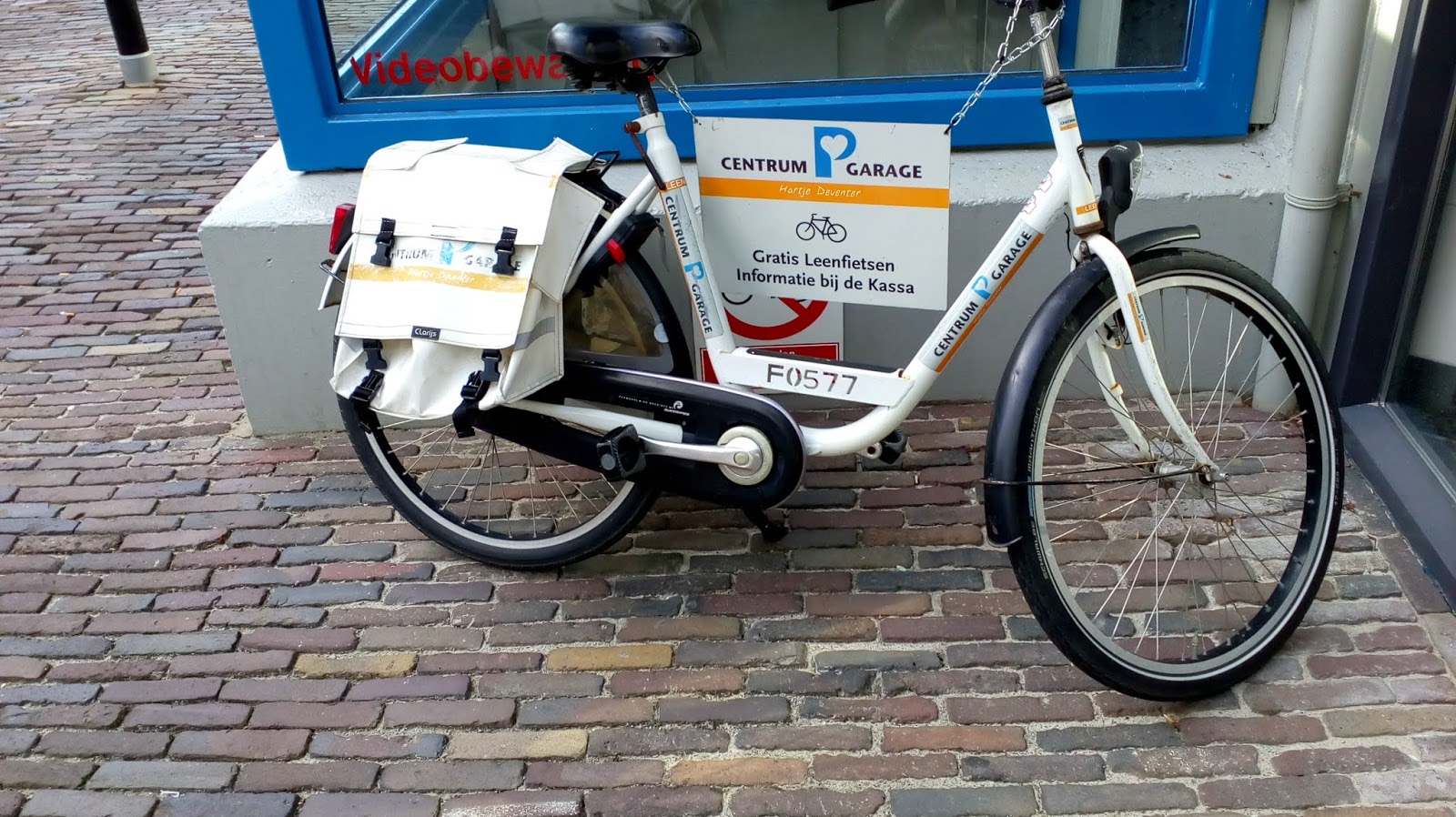
Meanwhile in Deventer (one of our stopover towns), the town centre car park operator had its own take on park and ride;


As you would expect in places where cycling has been enabled, there are plenty of other types of cycles being used. In Malmö, the postal service runs some high load capacity machines;


In addition, cycles are the vehicle of choice for deliveries as demonstrated by this well-known pizza company;


For one of our stopovers, we stayed about 30 miles from Hamburg and my son and I spent the day cycling along the River Elbe on very comfortable bikes - we needed them as it turned into a very long day as you can see from my Twitter thread from the day!


Of course, with so many practical machines being used, one kind of lets them become taken for granted and so the unusual does stand out such as these timber bikes spotted in Deventer and Utrecht;


As far as Denmark goes, there is a very famous attraction and of course, there is the odd bike to be seen;


And finally, you expect some cycle parking. Even in the less famous Swedish town of Ystad, there was plenty at the station!


Traffic Signals
No, not a long discussion on the technical points of European approaches, just a couple of the more unusual installations we saw. First, in Utrecht, the Rainbow Crossing is a bit of a tourist attraction in its own right, complete with Miffy signals!


Odense is the third largest city in Denmark and it is the home of Hans Christian Andersen. In celebration of this fact, someone has been messing about with the traffic signals;


In Copenhagen, a great addition to the pedestrian crossing push buttons is a little relief to help visually impaired people line up with the crossing direction. We could and should do this in the UK with very little effort;


City Vehicles
It's often the case that modern public service vehicles are simply too large to service historic places, but we stuff them in anyway. For when we can't do it all by bike (and nobody is suggesting we do), there is the option of appropriately sized vehicles. In Malmö, I saw a little electric maintenance van;


Vehicles of this size are perfect for when you need to carry a little more kit or stuff around, but where an 8-wheel truck is simply not appropriate. Over in Deventer, they have a little bus (Centrumbus) in the historic core. Although it's a very walkable town, the bus can give a little extra help to those who need it;


That's It!
Scandinavia was a blast, but as I said at the start of the series, please remember that the things I have written about come from a few days as a tourist, not someone who leaves and breathes the local engineering.

But, a highway engineer's adventures in time & space were fun over the summer and the journey continues. More than ever I can safely say the "the street is not too narrow, your imagination is too narrow", but seeing how it's done elsewhere can broaden one's imagination!