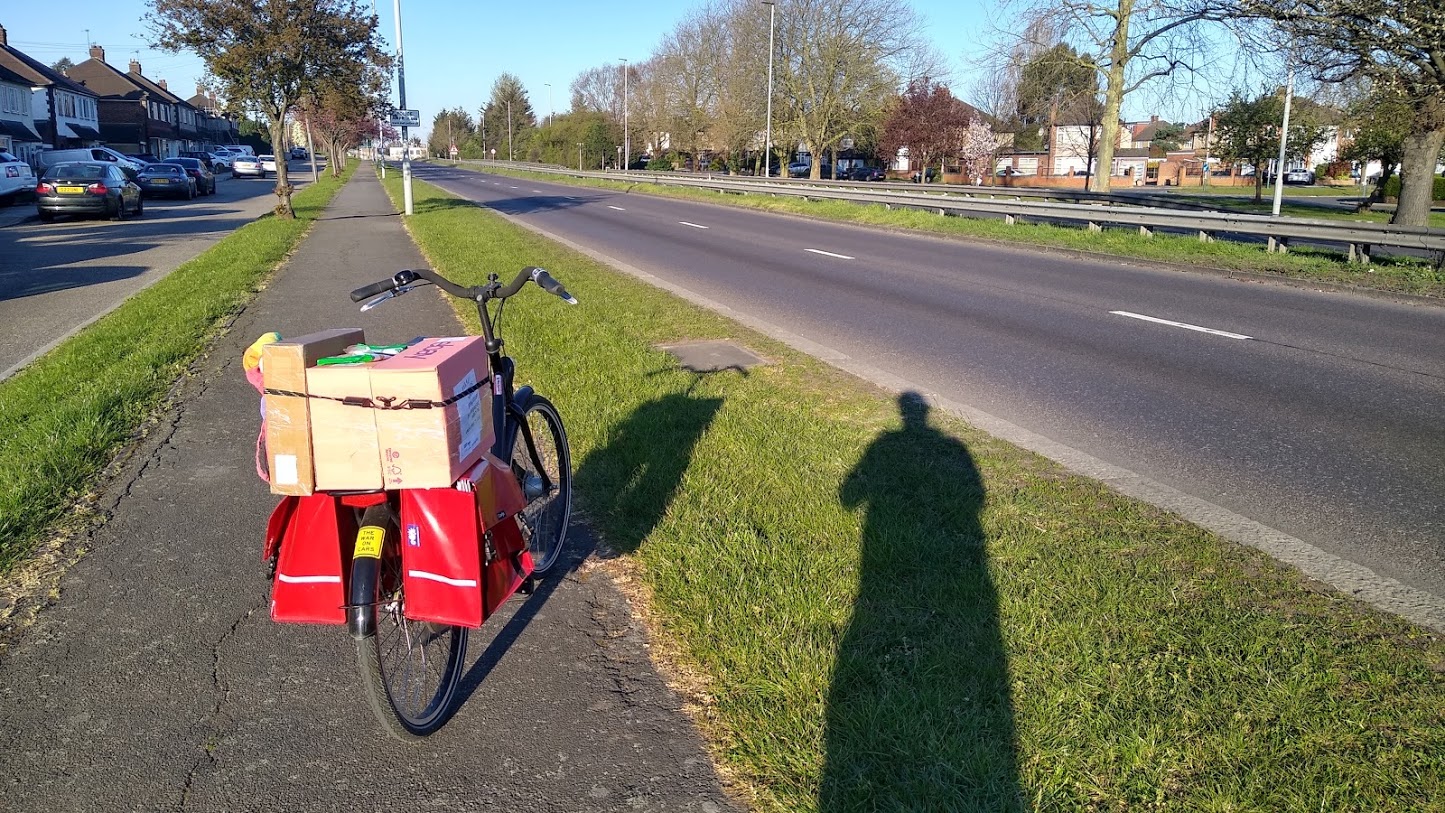
OK, so last week's post was a bit whiney about the lack of action from the Government on traffic orders in the face of Coronavirus and so this week, I thought something a bit more positive and helpful was in order.
I'm going to mention things I have before, but it's probably useful to have things in one place. If you're an advocate, please direct your friendly local authority councillor, planner or engineer to this post because it might inspire them.
In terms of governance, each highway authority will have processes for works to be signed off and so these should be followed. It is probably easier in a unitary authority as otherwise this will be a county council matter. For example, minor projects not requiring traffic orders may be delegated to a departmental head and larger projects may be with a cabinet member so it's worth checking out.
Designers also need to undertake proper risk assessments and keep proper notes setting out their design decisions - it's your design, not mine! We also must ensure we keep disabled people safe and there are ways we can assist such as stick down tactile paving.
The most powerful piece of legislation for making changes to highway layouts is held within Part V of the Highways Act 1980 - Improvement of Highways. In this part, there are all sorts of interesting powers given to highway authorities and I'll talk through some of the ones most useful in this current crisis. There's also other things which we can do which I'll pick up as I go along. This is the law in England and Wales and the rules are a little different in Scotland. Things are tougher in Northern Ireland because lots of things are done by order and I'm really not up on the mechanics of it - ask some questions please!
One point to make is that we cannot use these powers to close anything, so if general traffic is allowed on the street, this must continue to be accommodated, but that doesn't mean we have to allocate the same space it had before.
General Powers
S62 sets out the generality of the powers in Part V. Of interest here is the ability to;
The most powerful piece of legislation for making changes to highway layouts is held within Part V of the Highways Act 1980 - Improvement of Highways. In this part, there are all sorts of interesting powers given to highway authorities and I'll talk through some of the ones most useful in this current crisis. There's also other things which we can do which I'll pick up as I go along. This is the law in England and Wales and the rules are a little different in Scotland. Things are tougher in Northern Ireland because lots of things are done by order and I'm really not up on the mechanics of it - ask some questions please!
One point to make is that we cannot use these powers to close anything, so if general traffic is allowed on the street, this must continue to be accommodated, but that doesn't mean we have to allocate the same space it had before.
General Powers
S62 sets out the generality of the powers in Part V. Of interest here is the ability to;
- Vary the relative widths of carriageways and footways
- Construct cycle tracks,
- Install refuges, pillars, walls, barriers, rails, fences or posts for the use or protection of persons using a highway,
- Plant trees, shrubs and other vegetation,
- Install road humps,
- Install traffic calming.
The last two points are a little more complicated and require reference to other legislation.
Wider Footways
S66, paragraph 2 states;
"A highway authority may provide and maintain in a highway maintainable at the public expense by them which consists of or comprises a carriageway, such raised paving, pillars, walls, rails or fences as they think necessary for the purpose of safeguarding persons using the highway."
A footway is defined in S329 as;
"a way comprised in a highway which also comprises a carriageway, being a way over which the public have a right of way on foot only"
It's a wide ranging power and the materials aren't specified, so we can use all sorts of temporary materials to build or widen footways such as;
It's a wide ranging power and the materials aren't specified, so we can use all sorts of temporary materials to build or widen footways such as;
- Water filled barriers
- Flexposts
- Crowd barrier
- Traffic cones
- Bales of straw
- Concrete blocks
- Planters - manhole rings and large tyres could be cheap options
- Benches
- Bollards
- Paint (as long as we aren't mimicking road markings)

Planters in Malmö
Frankly, anything you can get your hands on which is not going to create a safety risk (trips, falls etc) and will be reasonably conspicuous to drivers. We've the general power under S62 to vary the width of footways and carriageways, so don't worry about losing road space.
Car parking will of course be raised as a concern (this is the carcentric UK of course). If there's no parking controls, then crack on. In theory people will be able to park on the outside of the temporary scheme (because it's the edge of the footway), but a single solid white line along the edge of the temporary layout might help provide a "kerb".
If the remaining carriageway is too narrow for two-way traffic then on the one hand that's no different to a narrow unrestricted street anyway. Obstructive parking can be enforced by the police and if it remains a problem, then things can be adjusted or followed up with a permanent traffic order. Each site will vary.
If there are already parking controls (waiting restrictions) then these apply to the width of the highway and so can be "floated" out to the new kerb line as can existing parking bays - the photograph below shows parking floated out for a painted cycle lane, but this can equally be the case for walking space.
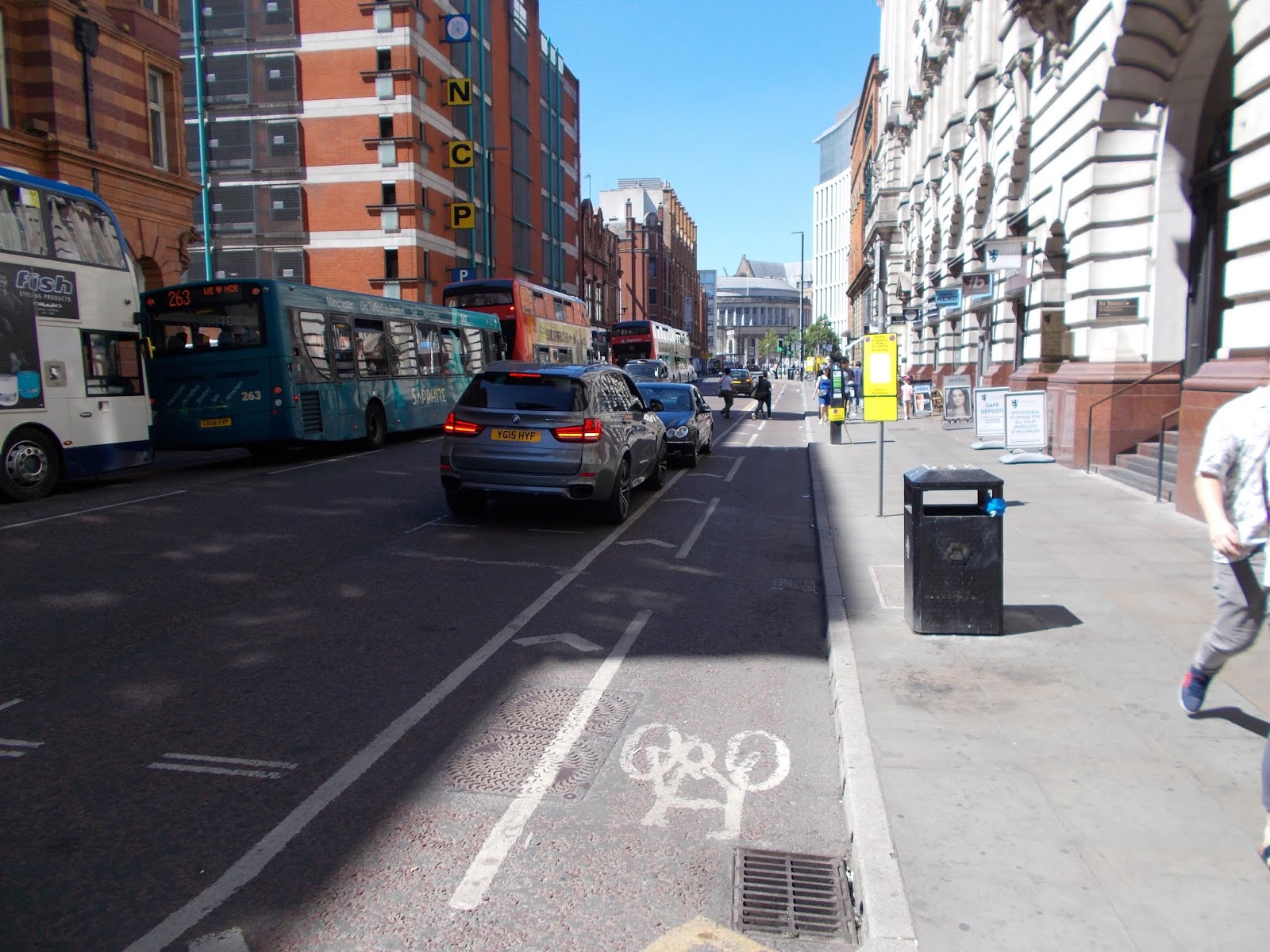
One complication could be where authorities use map-based traffic orders with the bays "described" graphically as being against the kerb, but I'd go for it because I think people are more likely to whinge if the bay is removed rather than it being moved laterally. If we decide we can't move parking (or loading bays), then fine, widen what we can and leave the bays alone because we have created more space than we had.
Also, this is the same section giving powers to put in pedestrian guardrail - and to take it out again. Now would be a perfect opportunity to see if it's really needed because it steals 0.5m (generally) from its set back from the kerb and perhaps a little more because you can't walk right next to it usually.
Also, this is the same section giving powers to put in pedestrian guardrail - and to take it out again. Now would be a perfect opportunity to see if it's really needed because it steals 0.5m (generally) from its set back from the kerb and perhaps a little more because you can't walk right next to it usually.
Cycle Tracks
S65 gives powers to build cycle tracks as follows in paragraph 1;
"...a highway authority may, in or by the side of a highway maintainable at the public expense by them which consists of or comprises a made-up carriageway, construct a cycle track as part of the highway; and they may light any cycle track constructed by them under this section."
A cycle track is defined under S329 as;
"a way constituting or comprised in a highway, being a way over which the public have the following, but no other, rights of way, that is to say, a right of way on pedal cycles... ...with or without a right of way on foot"
In other words just for cycling or shared. In general, we're not going to be worried about people walking or jogging in a cycle track, temporary or otherwise.
Again, we have a range of materials at our disposal as above and the same issues on parking should be considered, although having parking encroaching into a cycle track isn't going to work. For my mind, a row of wands and some cycle symbols might be enough to get us going.

Flexposts used to create a cycle track in Leicester
with the parking controls floated out
Planting
S96 gives the powers to plant stuff on the highway and this extends to fences, guards or other things to maintain or protect them (so that's planters formally covered).
Traffic Calming
I'm going to rule out road humps because they are rather more permanent that what I'm trying to help with in this post, but other forms of traffic calming will be useful and can be built with temporary materials. S90G contains the powers to to construct traffic calming and S90H states that the nature of traffic calming will be prescribed by the Secretary of State.
The prescription is contained in The Highways (Traffic Calming) Regulations 1999 and includes;

The photograph above shows some trees planted in the carriageway as traffic calming pinch point. It is not a requirement to provide signage to give any precedence of one traffic direction over the other, but each site will be different.
Junctions
The discussion above lends itself to linear changes, but we can make all of the same alterations to junctions to make them smaller, to take footways and cycle tracks across them, install refuges and so on.

The photograph above is from NACTO's Twitter feed and shows a junction narrowing using temporary materials. Other than the zebra crossings, we can copy this using our Highways Act powers. The zebra crossings do require a notice to be published under S23 of the Road Traffic Regulation Act 1984.
Controlled Pedestrian Crossings
The only actual legal consultation for a zebra crossing is the chief of police, but public comments will be considered by the highway authority as it sees fit.
A temporary zebra crossing will need tactile paving (could be stick down), dropped kerbs, zig-zags and Belisha beacons, but there are now battery-powered portable beacons and solar beacons so we have another options.
We can also provide signalised crossings in the same way. We have to use S23 because we're not putting them in as part of road works. This might be getting beyond a temporary layout, but it's a tool to consider. Again, we need dropped kerbs, tactile paving and zig-zags.
Mandatory Cycle Lanes
S96 gives the powers to plant stuff on the highway and this extends to fences, guards or other things to maintain or protect them (so that's planters formally covered).
Traffic Calming
I'm going to rule out road humps because they are rather more permanent that what I'm trying to help with in this post, but other forms of traffic calming will be useful and can be built with temporary materials. S90G contains the powers to to construct traffic calming and S90H states that the nature of traffic calming will be prescribed by the Secretary of State.
The prescription is contained in The Highways (Traffic Calming) Regulations 1999 and includes;
- build-outs,
- chicanes,
- gateways,
- islands,
- overrun areas,
- pinch-points,
- rumble devices,
- any combination of such works,
- Associated traffic signs.
We are also free to use planting, pillars, bollards, paving, railings etc. This is distinct from the footway widening and cycle track construction I have covered above because we are dealing with clearly defined installations.
Unlike the matters earlier, traffic calming does require consultation. The minimum requirements are to consult with the local chief of police (it's a formal thing) and "consult such persons or organisations representing persons who use the highway or who are otherwise likely to be affected by the traffic calming work as the highway authority thinks fit."
This might take longer because of decision-making process in the highway authority, but there are no traffic orders required and consultation does not mean agreeing with the feedback. With the traffic order process, the list of organisations to consult with is very prescriptive, whereas here it is a little less so.
Highway authorities will generally maintain a list of organisations they regularly consult with (probably the same as with traffic orders to make it easy), but there is judgement here with the scale of the works (not forgetting residents and businesses).
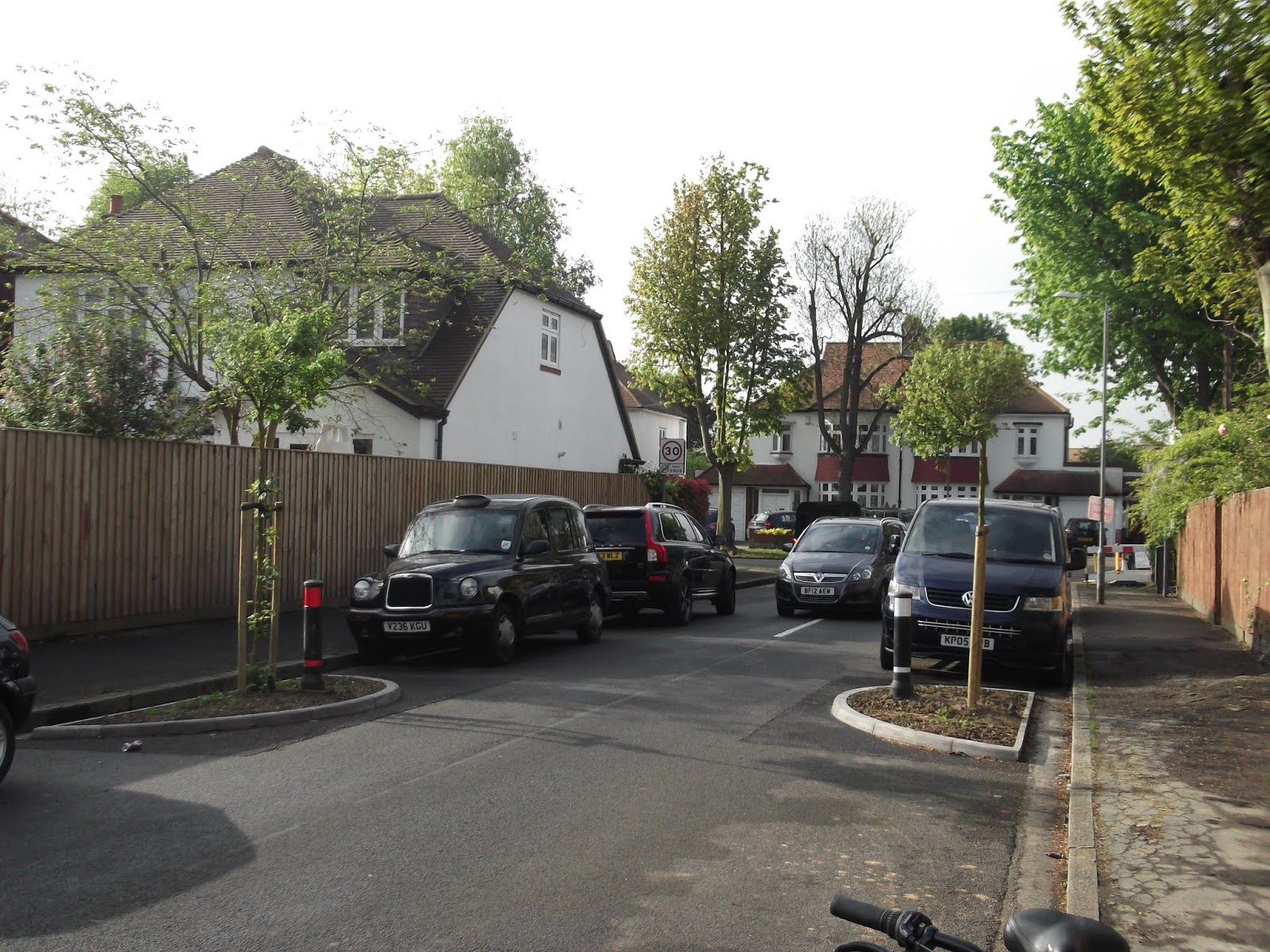
The photograph above shows some trees planted in the carriageway as traffic calming pinch point. It is not a requirement to provide signage to give any precedence of one traffic direction over the other, but each site will be different.
Junctions
The discussion above lends itself to linear changes, but we can make all of the same alterations to junctions to make them smaller, to take footways and cycle tracks across them, install refuges and so on.

The photograph above is from NACTO's Twitter feed and shows a junction narrowing using temporary materials. Other than the zebra crossings, we can copy this using our Highways Act powers. The zebra crossings do require a notice to be published under S23 of the Road Traffic Regulation Act 1984.
Controlled Pedestrian Crossings
The only actual legal consultation for a zebra crossing is the chief of police, but public comments will be considered by the highway authority as it sees fit.
A temporary zebra crossing will need tactile paving (could be stick down), dropped kerbs, zig-zags and Belisha beacons, but there are now battery-powered portable beacons and solar beacons so we have another options.
We can also provide signalised crossings in the same way. We have to use S23 because we're not putting them in as part of road works. This might be getting beyond a temporary layout, but it's a tool to consider. Again, we need dropped kerbs, tactile paving and zig-zags.
Mandatory Cycle Lanes
New mandatory cycle lanes (solid white line) do not need traffic orders and in theory can just be painted. Again, there will need to be some governance around decision-making. The main issue is the loophole in the rules highlighted by Cycling UK which means one cannot park in a mandatory cycle lane, but since the need for an order was removed in 2016 people can park in post-2016 lanes.
So, the best place to add a mandatory lane in my view is where there are already parking controls - double yellow lines would be best.
So, the best place to add a mandatory lane in my view is where there are already parking controls - double yellow lines would be best.
Advisory Cycle Lanes
Possibly a little easier than mandatory lanes, we can just put in advisory ones. Again, check the governance, but we can add them to existing situations or make current ones wider. It's not going to be perfect, but this is about showing the space. Normally I would say advisory lanes are a waste of time (they mainly are) but as part of a wider temporary scheme they have value I think.
If we also use them in conjunction with centre line removal, we might well have a bit of effect on driver speed as found by Transport for London. The Dutch do have some streets with this arrangement and a single width traffic lane for two-way traffic. In a UK context, I'd keep away from that, but a 5.5m general traffic space might be appropriate in many situations. We should also be painting them 150mm wide - too many authorities use 100m. There's a quick mock up of a before and after below.

If we also use them in conjunction with centre line removal, we might well have a bit of effect on driver speed as found by Transport for London. The Dutch do have some streets with this arrangement and a single width traffic lane for two-way traffic. In a UK context, I'd keep away from that, but a 5.5m general traffic space might be appropriate in many situations. We should also be painting them 150mm wide - too many authorities use 100m. There's a quick mock up of a before and after below.

Conclusion
the main conclusion here is to be clear of the decision making and governance processes in the highway authority and once that's known, there is lots we can toll out quickly.
Be careful to record design decisions and undertake risk assessments, but don't worry about perfection. If it looks right then it is right to a greater extent and we can make adjustments as we go. This is all very tactical and so keep an eye on the strategy as while this kind of work is rolled out, we can work permanent and experimental traffic order schemes which can add to or improve our tactical work.
In the longer term, we'll have some useful layouts in using temporary materials that we can gradually replace and given that the layouts have been installed with powers (and built on with items based on orders), we also have a set of shovel ready schemes.
Next Steps
This post is not aimed at individuals or groups doing their own thing, but you might be able to assist your local council in making things happen. The most important thing (other than getting stuff done) is to tell those stories and so when things get built, get out on social media and publicise what has been done and how it was done.
By getting the stories out, we'll give people the confidence that they can also pick up the ideas and run with them. As my post last week showed, we are not getting any leadership from the Government and so it is up to us to make things happen using the powers we have.
Be careful to record design decisions and undertake risk assessments, but don't worry about perfection. If it looks right then it is right to a greater extent and we can make adjustments as we go. This is all very tactical and so keep an eye on the strategy as while this kind of work is rolled out, we can work permanent and experimental traffic order schemes which can add to or improve our tactical work.
In the longer term, we'll have some useful layouts in using temporary materials that we can gradually replace and given that the layouts have been installed with powers (and built on with items based on orders), we also have a set of shovel ready schemes.
Next Steps
This post is not aimed at individuals or groups doing their own thing, but you might be able to assist your local council in making things happen. The most important thing (other than getting stuff done) is to tell those stories and so when things get built, get out on social media and publicise what has been done and how it was done.
By getting the stories out, we'll give people the confidence that they can also pick up the ideas and run with them. As my post last week showed, we are not getting any leadership from the Government and so it is up to us to make things happen using the powers we have.
Resources
Here's a couple of resources for inspirations. First, NACTO gives a bit of free advice on it's website on interim design strategies. or you might get some inspiration from the Tactical Urbanist's Guide.
Shameless Plug
I don't usually do this through the blog, but if you are a local authority person and need some proper help with this, get in contact and we can discuss a commission. My day job commands a significant staff resource with plenty of clever people who can advise from a design and safety point of view.