Sunday, 26 February 2017

The Amazing Electricity Trickery: Recharged

Four years ago, I wrote about the Government's push for electric and so-called "ultra low emission vehicles" (ULEVs). There has been some media coverage of ULEV/ EV subsidy and so I thought it worth having another look at the subject.

When I last wrote in 2013, there was a budget of £400m available through the Office of Low Emission Vehicles (OLEV) which was being used to provide grants towards private and commercial ULEVs which was due to end in 2015. Of course, this was under the previous Conservative/ Liberal Democrat coalition.

We still have OLEV and it has been tweeting some things recently. First, that the ULEV grant system is still alive and well. It has also been trailing the fact that one can obtain grants towards domestic and workplace charging points. Finally, it has been tweeting the news that the Government will be pushing to improve the availability of EV charging points (possibly through changes in the law) as part of the proposed "Vehicle Technology and Aviation Bill". On the latter, there will also be the introduction of an insurance regime to cover autonomous vehicles (AVs).

In short, the Government is putting its weight behind a future filled with electric (or at least low-emission) vehicles and autonomous operation. In many ways, this is no different to many other countries who are seeking to dump fossil-fueled vehicles such as the Dutch and Norwegians. The whole area is a multi-trillion market and one can see why the UK Government is pushing to be part of it, more so given the uncertainties around leaving the European Union.

On the one hand, we will probably be using motor-vehicles for the foreseeable future and so they may as well be electric. At the very least, the tail-pipe emissions problem in urban areas will be addressed, although there are still plenty of issues created by braking systems and the action of tyres on roads. On the other hand, this represents a push to maintain business as usual and in that I mean to continue with a car and lorry-based UK transport system and anyone using active or public transport be damned.

It was interesting to read concern raised about vehicle excise duty being changed from April this year which meant that many owners of "gas guzzlers" would be paying less VED, whereas those driving "cleaner" cars would pay more (zero-emission cars will still be exempt). Forgetting about the weird discrepancy, this is the Government realising that as cars get more efficient, VED revenues will fall. With fuel duty too, aside from the fuel tax escalator being removed, a switch to EV and ULEV vehicles is going to see revenue drop as well. I fully expect to see changes whereby EVs will attract VED and as for fueling EVs, it will be interesting to see what happens as they are really cheap to run. It will also be interesting to see what the traditional fossil fuel companies do in terms of production and divestment in the next decade as the current push must surely go against their traditional business model!

Of course, subsidy and tax are part of the same system used by Government to influence a particular market sector in response to their stated policies. Unfortunately, in the UK, it seems to be about trying to compete for the "business as usual" sector with nothing of any substance being made available for local active transport. In truth, this area of transport is almost always neglected - at least it has seemed this way to me over the last 20+ years in my industry.

On Twitter, some people questioned OLEV about the potential for subsidy/ grants for e-cycles;


OLEV were pretty clear and in truth, e-cycles are not part of their remit. Someone suggested that the grant system was similar to the "Cycle to Work" scheme, which is essentially a tax-efficient mechanism which allows an employer to "lease" a cycle to an employee and for the lease to be paid before tax. At the end of the "lease" the employee purchases the cycle from the employer at a market rate. If you are in work and your employer runs the scheme, then you can save money. Otherwise, it's no use to you. It's rather different to the ULEV grant scheme which is basically money off the vehicle when you purchase it and the dealer will sort out the paperwork for you; there isn't even an applicant form!

E-cycles can help with our urban pollution and congestion problems. They can give range and help to those who would otherwise struggle with a conventional cycle. They enable heavier loads to be moved for those important "last mile" freight journeys and indeed, can help with family transport in terms of e-cargo cycles. If the Government valued transport diversity then it would extend the ULEV scheme to subsidise e-cycles. Of course, it doesn't deal with the infrastructure issues which have been largely ignored. England is still waiting for meaningful funding under the Cycling and Walking Investment Strategy (CWIS) as are the devolved administrations.

There is also the current concern about people using finance schemes to buy new cars becoming the next sub-prime financial disaster. If you have Government policy set up to perpetuate car ownership through road building and enabling car use, then there will be many people needing cars who can't afford to buy one out right. If your town has expensive and unreliable public transport, if the roads are not safe to cycle on, or if you have to get around to multiple destinations (care workers visiting people at home for example), then life without a car will be difficult.

As ever, this goes back to Government priorities. I'm afraid that I am quite pessimistic these days. It seems that the push to maintain the current model attracts copious amounts funding, ministerial support and the allied industries rushing to get their collective hands on the subsidies (because that is where the cash is going) - hell, there are even design standards for motorways! 

When it comes to local active transport, every infrastructure project seems to be a fight. Funding is hand-to-mouth and we have inconsistent approaches to design because walking and cycling are always "matters for local authorities". Compare the UK with other countries which are seeing a low emission future; they are investing in local active transport and therefore seeing that there are different tools for different jobs. Of course, ULEVs are just a part of the story, but this is a story which, as far as I can see, won't have a happy ending.

Friday, 17 February 2017

Hoopla!

Storing cycles at home is a conundrum, especially for people renting, those living in apartments or those with little space.

I am not going to be able to solve everyone's storage problems, but I might be able to inspire some of you to either improve your own storage or at least show landlords that it could be very easy for them to provide some.

Apart from all of the obvious points about infrastructure which enables people to cycle, one of the important little things I have done for my own cycling convenience is to install cycle parking hoops in the front garden. I originally installed two; one for my commuting bike and the other for family bikes when we didn't want to/ couldn't be bothered to stick them in the shed. 

Lugging cycles through the house/ along alleyways or upstairs to balconies is a pain in the backside at best and impossible at worst. As a sometimes cargo-triker, getting the machine into the shed wasn't going to happen and so the second hoop (with a supplementary wall anchor) was used up. My son sometimes cycles to school and having to get his bike in and out of the house was a pain, so he needed his own hoop.

The point is one of convenience. For the commute, I don't need the faff of getting my bike in and out of the shed (especially in the winter when enthusiasm to go out in the cold takes a little more effort) and so a hoop out front is great. The downside of course is cycles are out in the weather, but they can be covered and if it helps to stop the easy reach for the car keys then storage has to be simple.

The point of all of this is that I needed to add a third hoop and so this is a little guide to how it can be done. There are two ways hoops are installed and that's either concreting them into the ground or bolting them down. Personally, I would concrete them in every time because even with anti-tamper nuts (stop laughing at the back), they are relatively easy to remove with an angle grinder. In fact, I've been known to lock my bike to the uprights of a cycle shelter in preference to the hoops being covered!


So, our first job is to dig a hole; easy right? A word of caution. You might think digging in your front garden is safe, but this is where utilities can be found running from the street to the building and so you need to exercise safe digging procedures. If you want to scare yourself, read HSG47 by the Health and Safety Executive.

If you are put off now, then don't feel bad about it, digging through utilities is a serious subject. Utility services through gardens are rarely mapped and although they should be deep enough, we can never take it for granted. Just because you might have a lawn, it doesn't mean it is free from buried utilities. So, taking on board the issue, we can manage the risk by being gentle and methodical. This is something a competent DIYer can do themselves.

If you are digging in a grassed or soil area, then you don't need to worry about pulling up paving. I had to take up some block paviours which involved a lump hammer and bolster to break a couple and then easing them out with a little crowbar. If you are going through a a concrete slab or tarmac, then it is a little more tricky in terms of breaking up the surface and so you will need a breaker. The key here is to just get through the surface paved layer, no deeper at this stage.


Once you are through the hard layer (or even just under turf level) then you can start to dig. In the photo above, you can see my digging tools - a hand fork and strong plastic trowel. You can also see a lump hammer which used with the bolster to break through a thin layer of concrete under the block paving sand bed (it was very weak).

The key here was to think like an archaeologist and to dig a little at a time. The fork was for gentle loosening of soil (thick London clay for me) and the plastic trowel was for digging out soil and scraping the hole into a decent shape. I did find stones and so gently used the little crowbar to nudge them, keeping a sharp eye out to make sure I wasn't tugging on a utility! By working carefully and exposing anything which wasn't soil gently, I managed the risk of hitting a utility.

It would of course have been easier to go flying in with a small digging spade, but unless you know the area is free of utilities, it's a bit risky. Once I had the hole down to 450mm, I did use a small digging spade to scrape the holes a little larger and to square off their bottoms. The holes were about 250mm diameter.


When you order cycle hoops, you need to be sure they aren't coming out in a hurry. Most suppliers give an option on how they are fixed and assuming you go for my recommended concrete-fixed version (often called "root-fixed"), they will come with the ends crimped flat so they can't be pulled out vertically. It happened that my hoop had splayed ends. Some come with a plate on the bottom or even a bolt drilled through. In my opinion, crimped (and splayed) are the best options.


For concrete, I took the cargotrike down to the big-box store (helped by #TheDoodle) and picked up two bags of rapid-set concrete. You can also use post-fix - I went for rapid set because it cures, well, rapidly. This meant I could use the hoop later in the day, post-fix or hand-mixed concrete will need a day or so to become strong enough.


The rapid-set concrete is pre-mixed, you just have to cut the bag and pour it into the hole. You need to add a little water as you go and it's worth using a little piece of wood to tamp it down as you place it as you want the concrete "plug" to be nice and dense.


One of the risks with rapid-set is it going off before you've checked the post is level and plumb. I used my trusty magnetic spirit level to make sure the installation was spot on. With ordinary concrete, you do have more adjustment time!


After 20 minutes of filling the second hole, the concrete had cured (it's a chemical reaction, it doesn't "dry") enough for me to replay the block paving. I simply put the bedding sand back in, tamped it with the lump hammer and then relayed the blocks, tamping them into place. I will put some kiln dried sand in the block joints to make sure they lock in place.


All that was left was for me to put a little bit of concrete around the base of the posts to fill the gaps around them and then tidy up.


Once I had cleaned and put my tools away, the hoop was ready for use. So there you go, despite my warning about buried utilities, it isn't too difficult to install a cycle hoop. Cost-wise, expect to pay around £35 for a basic galvanised steel hoop. There are lots of options for them to arrive painted or even PVC coated and stainless steel (but these are more expensive). The concrete I used was £6 a bag.

To get someone in to install a hoop for you, you are probably looking at at least £250-£350 all in (depending on who and if any paving needs replacing). So there you have it, a job you could tackle yourself or not too costly for a landlord to help their tenants. Hoops can be cut, but so can shed locks. The aim is to keep your cycle handy and deter thefts, so the hoop and a couple of D-locks is a pretty cost-effective solution.

Thursday, 16 February 2017

Inside Our Streets: Wireless Magnetometers

This is the first of an occasional series which gives a little introduction to some of the "things" we put in, on, or under our streets to help them function. This week, wireless magnetometers as used with SCOOT.

I covered SCOOT in a previous post which referenced magnetometers, but to recap, the devices (specifically the wireless kind) are gradually replacing loops cut into the road surface to detect traffic (motors and cycles). 

By loops, I mean wires which are cut into the road surface (see image below) which count the flow and/or speed of passing vehicles. They can be set up to detect cycles, although there is the odd complaint about junctions where this doesn't work. Loops work by vehicles affecting the inductance of a tuned electrical current as they pass over them (more here).


Traffic loops - lower image in red to highlight them.
Area circled yellow is an inspection pit.

There are a few issues with loops;
  • They are cut into the road surface which creates the potential for water to get in if the sealant to the cut fails. This can lead to potholes.
  • Where a road is resurfaced, the loops are often destroyed by the planing machine as they are usually installed at around 40-70mm deep.
  • The loops need to be directly connected to the traffic signal system. This means pits at the side of the road (see above, circled yellow) and extensive ducting where lots of detection is provided (on higher speed approached for example).
  • Road workers are exposed to safety risks during installation in terms of traffic, dust from cutting and noise (even though this will be controlled with traffic management and protective equipment).

Wireless magnetometers are installed in the centre of a traffic lane by core-drilling a hole, putting in some resin bedding, inserting the unit and then topping up the hole with more resin. Siemens has a natty little installation guide here. The installation still involves road workers being out on the road but it's a much easier and quicker task.

OK, lets look at a wireless magnetometer up close and personal;

The little circle of resin is the clue.

Zoomed in. It's 100mm in diameter.

Here's a unit removed from the road, encased in resin.

The depth of the hole was about 70mm.

I've removed the resin from the top of the unit. As the
resin is poured in two parts (bedding then topping) it's
fairly easy to prise open.

Here, the magnetometer is removed showing a plastic
shell in which it sits and which is in turn bedded into
resin poured into the cored hole.

The magnetometer is about 70mm square and 50mm
in depth. When it is set into its resin bed, it is about
6mm below the road surface.

Here, I've removed the top to show the internals. From
here on, it's all sealed in clear silicone.

Now don't worry, I haven't gone out and prised a magnetometer out of the road, this one was removed prior to some resurfacing and was replaced, although they can be reused. A planing machine would destroy the unit easily, but it is best to pop them out first!

In terms of operation, you may have noticed additional boxes being added to certain traffic signals at junctions. These are called "access points";


These are different from microwave vehicle detectors (MVDs) that you see aimed at traffic. Access points essentially collect the detection data being transmitted by the magnetometer which has an on-board battery (8 to 10 years life) which runs a low power transmitter. In some circumstances, the magnetometers "talk" to repeater units which allow detection a long way before the junction as typically, magnetometers will be within 40 metres of an access point.

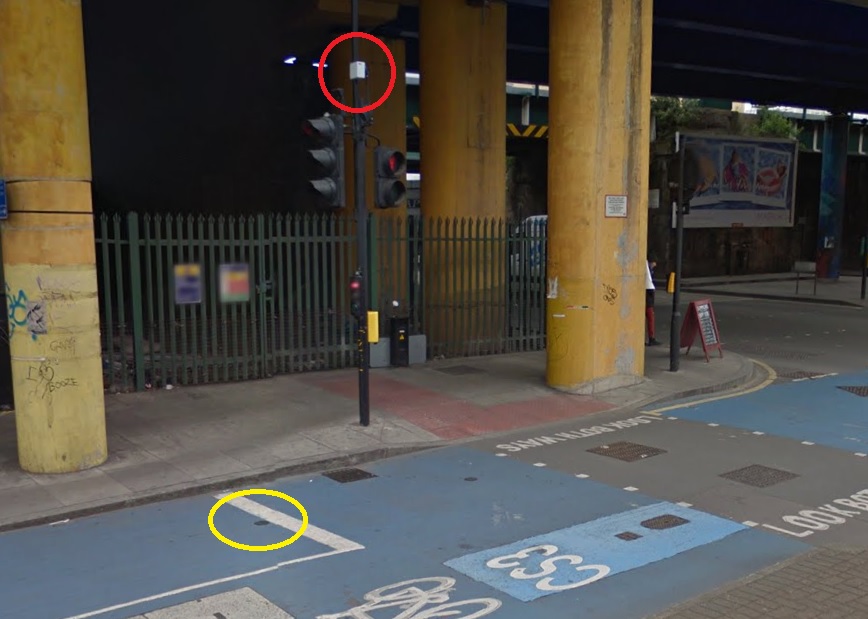
Access points can handle multiple magnetometers and so when taken as a whole, we can construct some very clever arrays of detection approaching, within and leaving junctions. This is very cool stuff, especially where with have an urban traffic control system such as SCOOT which runs traffic signals on an area (and city-wide) basis. For those interested in cycling, the technology is being used now. The image below is on Cable Street in London;


The magnetometer is circled in yellow and the access point in red. In this location, cycle demand is actually detected by another sensor on the traffic signal and so the magnetometer is being used to detect flow into the junction. However, we could as easily place a magnetometer well in advance of the stop line and trigger demand before people get to the signals so that a green may come immediately - something we haven't really got to grips with yet.

So there you have it. A little plug of happiness making our streets run that little bit more intelligently.

Saturday, 11 February 2017

#10by2020 : A Personal View

I attended another Stop Killing Cyclists protest today which was calling for the Chancellor to invest 10% of the UK transport budget by 2020 in protected walking and cycling infrastructure.

The protest had been planned for a while, but took on additional poignancy in the light of more people being killed in London this week while walking and cycling - people like you and me just trying to go about their daily business.

"Protected infrastructure" is a very important point; we are talking about physical, tangible work to change our streets. Compare this with short-term (and relatively cheap) soft measures, advertising campaigns and personal protective equipment (aka hi-viz and helmets). On the one hand we have an approach which has a long life, will (with appropriate maintenance) be an inter-generational investment and it protects at a population level. On the other hand, we have an approach which is transient, short lived, only deals with the individual; and ultimately, has nothing to show for the money.

Changing our streets is controversial, sometimes technically difficult (but that's for engineers to sort out) and politically it seems to be a fight for every change; whereas, soft measures are an easy cop out because it doesn't deal with making decisions on space. The UK Government is not shy about investing our money in huge road schemes, huge railway schemes and the so-called nuclear deterrent; but it is nowhere to be seen on providing the lead on local, active transport.

All too often, funding for active travel is provided through local authorities bidding against each other for a derisory share from a derisory pot. This money is never the long-term investment which is needed and a fair bit gets used just trying to get schemes going. This is not a good way to invest and it certainly doesn't work that way for the big ticket national-level projects.

One of the speakers today talked about how cholera in the 19th Century was ultimately defeated by infrastructure investment. This echoes the 21st Century where our motor-transport system has created a public health emergency which will only ever be changed by infrastructure. Civil engineers are here to solve society's infrastructure problems; but the one thing we can't solve ourselves is the political issue. This is a group effort and it's why I was proud to be standing, with my 2-year old daughter, shoulder to shoulder with everyone else.

As is customary, I'll leave you with some photos of the day.


Saturday, 4 February 2017

The Devil Is In The Detail

It is normally the case that it is no more expensive to do things well than do things badly and in the case of the "things" on our streets, this holds true.

I am sometimes called a "Kerb Nerd" and this is a badge I wear with pride because it is the little details which can make all the difference. Perhaps it's not make or break time, but those things which don't quite work can at best be an irritation to someone like me, but at worst they mean a scheme or a feature doesn't serve the end user properly.

A simple example is the humble pedestrian dropped kerb which I go on about all the time. The kerbs need to be flush with the road. The slope needs to be gentle and we need tactile paving. The various elements used to construct a dropped kerb cost the same whether it is done right or not. 

In my experience, our road workers on site are experts (in general) in installing the features we need. In fact, there are many craftspeople out there who take take the most basic materials and make them look good. I've even known people who will point the joints on the inside of a brick-built chamber as if it was a piece of art on show to all. Nobody will ever appreciate their quality of their work, but they take pride in their work.

I need to wag my finger at the designers and specifiers who all to often get things wrong. Even worse, they don't take sufficient interest and leave the people on site to try and cope with their half-completed drawings and garbled instructions.

But taking a step back from even that, somebody is paying for work to be done. Whether it is a public authority or a developer, employing designers and contractors costs money and so it is in everyone's interest to get things right first time. However, like with much in life, one gets what one pays for, and design and construction is no different.

If you want a cheap design, then expect to have something designed from the comfort of the office by someone given a cap on the hours they can spend on the commission. If you want a good design, then expect to pay for the designer to visit the site a few times to understand the layout and then for them to be able to spend enough time to make sure the scheme fits together properly. It's also a very good idea for the designer to be involved in the construction too. Price is an important consideration, but in any contract there really needs to be a quality component; and this goes for contractors too.

I keep seeing the same things when I'm out and about, so here are 5 more things which people seem to struggle with getting right - aka little pet hates of mine (in no particular order);

Kerbs on a radius
Unless you are going to the effort and expense of having custom-made radius kerbs, you will be using a set of standard ones. They are generally available in radii of whole metres, but not at 7, 9 or 11 metres - and some profiles have even less choice. Have a look at this data sheet by Marshalls for precast concrete kerbs to see what I mean.

When I see a drawing showing a radius of say 4.5 metres, I know immediately that it will be a bodge involving cutting kerbs to make them fit or by having open joints somewhere and it will look terrible. Specify either 4 or 5 metres - it is not difficult.

Sometimes, people try and use straight kerbs to form a radius. For 12 metres or more, its fine. You can get away with going down to 8 metres with straight kerbs, but any less and it looks awful. We have the right kerbs available and we should use them.

Lay-bys and build-outs
Kerbs again. Where a lay-by is formed or the footway is built-our, we will often see sharp points or internal angles. Again, it will look like a bodge. Sharp points will be tyre shredders and angles will make it hard to mechanically sweep the channel (as with the photo below).


The correct way to do it is with carefully sized and set out radius kerbs which allow a nice sweeping kerb line rather than those corners.

Small paving cuts
This is where huge amounts of effort get expended in trying to fit rectangular paving to curves and where levels change but where we cannot of course bend paving slabs! We end up with small pieces of paving which will end up rocking and moving which is no good to walk on.

The solution is to plan the cutting regime so that large pieces are kept and it is the small pieces which are thrown away. A pragmatic solution is sometimes to use small element paving in tight spots (block paving for example) which is formed from stronger units.

Double-sided signs
A classic example is the entry/ exit points of 20mph zones. Often, we see a post stuck in the footway with two separate signs (one saying "20" and one "30"). It is really quite simple to have the sign made double-sided and the fixings taken from one side with the post at the back of the footway. It just looks more tidy.


This takes thought as the side fixings need to be on the correct side and we will need to check we can get the sign post in. Compare with a "from the office" design, we'll just get a symbol on a plan with no care about positioning.

Silly sign posts
How many times do we see a traffic sign (often parking-related) on a post when there is a lighting column right next to it? Oh, it's just me who worries then! This is another example of people either not going to site or not thinking beyond their own little task.

There are limits on the size of sign which can be attached to a lighting column because of the effects of wind loading, but basic parking signs are small and we should use the things already on the highway for more than one job.

If we are being really dedicated, we can look at attach signs to buildings or walls. Of course, we need to get agreement from the owner, but it saves a post (which can end up getting hit, or the sign rotated) and it just looks so much better. Care should be taken that the sign can be seen.


Good design is about having time to think, about understanding the construction process and very importantly, the needs of the end user. The job of the highway engineer/ designer is to take the array of elements and techniques we have and to combine them in an appropriate manner. Good detailing takes effort, but it is essential for a useable and durable end product.