Monday, 27 May 2019

School's Out

It's the school holidays and so it might be worth having a whinge about the obsession that they have with two things we can add to our streets which don't really have much of an impact.

As I near the end of my local authority career, my anecdata would suggest that it is school warning signs and pedestrian guardrail which are the popular request from schools. I am not totally sure why this is, but perhaps;
  • they are relatively cheap wins which appeals to the "something must be done",
  • many teachers and head teachers are drivers and they come at "road safety" from a traditional motor-centric point of view (certainly an Outer-London perspective),
  • they are simple 'solutions' compared to lobbying for meaningful change, especially if schools have limited resources to campaign with.
Also, being truthful, for a local authority office, putting in signs or a bit of guardrail is equally easy as it needs no consultation, looks like something is being done and it gets the school off one's back.

Over on Twitter, we often use the hashtag #SignMakeItBetter and at schools, it's no different;


The photograph above is a school warning sign on steroids. OK, it warns of a school crossing patrol, but the "patrol" plate can be swapped for "school". Just look at it, flashing amber signals, bright yellow. Fantastic.

Even with a basic warning sign, it is fairly and squarely aimed at warning drivers that there is a "hazard" ahead - that's what the triangular sign means. There is a hazard ahead and you should modify your behaviour. Great, there are kids milling about because it is school time and they are a hazard to drivers. Can't we see how upside down this is? 

Warning signs are overused (at least in urban areas) to the extent where they are pretty meaningless. There might be some reactive value where a school is near a road with a speed limit of 40mph and greater, but other than that, it is reasonable to expect there are children walking to school twice a day in built up areas.

Guardrail is requested for three reasons - to stop people parking outside a school, to stop the little ones running out of the school gate and straight into the road and to stop drivers getting onto the footway (either parking or crashing).


As you can see from the photograph above, guardrail does not stop parking. In fact, it often means that children being dropped off leave the vehicle on the live traffic side and then walk along the road to the end of the guardrail. Of course, it stops parking on the footway, but so would some bollards, planters or trees.

As for physically stopping a speeding driver? Not a chance;


The most tricky one is using guardrail to stop the nippers running out into the road. I have yet to see any study which looks at the safety impacts of providing guardrail in front of school entrances. I think it's more about making people feel secure and to be fair, that's a perfectly rational safety argument - experienced safety. However, a school could equally place guardrail inside its premises to have the same impact and not take away footway space.

Perhaps a footway doesn't have enough capacity to contain the people milling around at school travel times and so some guardrail could help stop people (especially children) getting jostled into the road, although we set it back from the carriageway which means more footway lost. For me, the answer here is to make sure there is good capacity for people to get in and out of the school and if overcrowding is the issue, then more footway space is the answer.


The ultimate answer of course is to take the space outside the school away from drivers (school streets as they are often now called), such as outside Heald Place Primary School in Manchester (above) where a dozen bollards and a couple of traffic signs dealt with the problem which traffic calming, guardrail and parking controls couldn't.

Sunday, 19 May 2019

Practical Loading

The need for business loading is often cited as a reason not to build cycle tracks, but it's a spurious argument. 

Businesses absolutely need to move goods around to function and in fact, when we upgrade our streets to provide new cycling infrastructure, loading can be easily accommodated.

It's obvious I suppose, but for the foreseeable future, we are still going to be using vans and lorries to service businesses and we absolutely should make provision for loading because if we don't we'll have delivery drivers parking on the cycle tracks and footways.

The good news is that most businesses don't have deliveries made by 40 tonne articulated lorries and so making space at regular intervals allows delivery drivers to legitimately stop in a safe location and not have the stress of having to rush while they make their deliveries.


The loading bay above provides servicing space for an adjacent area which cannot be accessed by traffic during the day and a residential complex opposite. The cycle track is stepped in this case, so there is a dropped kerb with gentle ramp to get to the cycle track with a trolley and the forgiving kerbs are easy to roll over.


This loading bay is next to a carriageway level cycle track with a gap in the skinny protection island to allow the delivery driver to wheel his trolley over.

In some cases, there might be a space compromise if a street performs a vital motor traffic movement function and so with a loading bay in the main carriageway, then only allowing loading off peak might be appropriate rather than impacting on the space and time continuity of the cycle track.

One of the key things with providing loading space is that it should be considered as a higher priority than car parking. In fact, bus stops and loading bays are vital for the operation of our urban places and car parking less so (other than for disabled people who might need it). If there isn't space on the main road, then we could use a side street to provide a loading bay to keep the main road clear.

Of course, what is often forgotten is that building cycle tracks means that we can shift some deliveries to cargocycle. The beauty of this is that we can stop right outside the business and cut down on the time walking between loading bays and the front door. Cargocycles can also be taken right into the building as shown by Pedal Me below!


Sunday, 12 May 2019

A Stratford Safari: Redux

Back in September last year, I reported on the scheme which was transforming Stratford's town centre by removing an old gyratory system. So how is it looking now it's finished?

My previous post covered most of the layout which was Broadway (Southern side) Romford Road to High Street) and The Grove (by Broadway) and so this week I shall be looking at Great Eastern Road which runs opposite Stratford Station, Broadway (northern side) and a couple of side roads. I'll also cover a couple of issues which remaining concerning from the first post and there's a video of the whole scheme at the end.


The photo above is of the Railway Tree sculpture which is on the western side of the junction of High Street (behind me), Broadway (south side) over to the right and Great Eastern Road (where the bus is to the left).

In the photo, you can just see the cycle track which heads northeast towards Romford Road. For Great Eastern Road, you cross to the far side and turn left to head towards the station. As with Broadway, Great Eastern Road is two way for motor traffic. Annoyingly, the crossings are push-button rather than detected.


The crossing of the junction is in two halves and the two stage arrangement links to crossings for other directions. The photograph above shows the second crossing (heading northeastbound) with a one-way cycle track peeling off to the right and the two-way cycle track on Great Eastern Road to the left.


On Great Eastern Road (above), the two-way cycle track skirts the eastern side of the street which perhaps makes some sense because the other side is a major bus to rail interchange and people would be wandering across the cycle track. It does, however, seem to be a missed opportunity to provide a spur link to the station as the access relies on a toucan crossing.


The general design approach has a couple of features which continue to annoy me about London and that is a lack of centre line on two way cycle tracks and the kerbs. The centre line only appears at "conflict points", but in my view, a shorter line with a longer gap is needed elsewhere just to remind people that it is two-way. The kerbs have a low upstand (about 25mm) and have a 45° splay which means if you go too close or try to mount them (to get off the cycle track to stop) you will get a wheel grabbed.


We need to stop using this type of kerb and just copy the Dutch approach which gives a 50mm/60mm upstand and a gentle slope. This allows visually impaired people to detect the kerb, is safer to cycle on, allows people to cycle on the full width and for those using their cycle as a mobility aid, they can easily roll on or off the track.


Opposite the station, there is a floating bus stop (above) with a mini-zebra crossing. which seems to work reasonably well. The driver of the bus in the photograph below has stopped perfectly (the front wheels should be in line with the bus stop flag). Anyone getting off the bus and wanting to use the crossing would be walking towards oncoming cyclists nearest to them. I would have put the shelter in the other way round though and had the back of it by the road.


As I mentioned, access to the station for people cycling is via a toucan crossing (below). To use it you have to get off the cycle track and swing round to cross with pedestrians. 


One good thing about this side of Stratford is that the cycle track has been machine laid, so it is nice and smooth. Some of the earlier work has not been machine laid and the ride quality suffers.


At the junction with Angel Lane, the cycle track crosses Great Eastern Road. Angel Lane is the A112 which becomes High Road Leyton further north and so Stratford town centre is tantalisingly close to connecting with Waltham. As an aside (above) the cycle track humps very gently to pedestrian crossing points and there is annoying blue surfacing at them and other "conflict points".


The photographs above show the junction with Oxford Road. The footway and cycle track is continuous which is good, but the opening for motor traffic is on the large side. There are a couple of bollards which kind of pick out the width of the vehicle entrance, but being black means that they are a safety risk for people cycling through.

Just a little further on is the junction with Grove Crescent Road into which the main cycle track disappears (below).


By disappears, I mean it ends at a modal filter which suggests some sort of future route.


The filter is substantial with lumps of stone as bollards (above) which do present a safety risk to people cycling, despite the decent splitter paintwork!

For those staying on Great Eastern Road, the route carries on until it meets The Grove, although disappointingly, it ends at a shared area linking to toucan crossings which I'd assume is a motor traffic capacity issue. There is a handy transition back into the carriageway of The Grove for people wishing to cycle to Maryland Station (below). 


One other feature of the main scheme is the removal of through traffic from the northern side of Broadway. This used to be a major bus interchange and area heavily used to drop off and pick up people by car. That has all gone and now there is a pedestrianised area more fitting the location between the shops and St. John's Church.


The area does allow cycling and a suggested route is provided by contrasting paving and a level surface. This is not a key through route for people cycling, just a link to the shops and amenities and I think this works well. The area is positively signed as a pedestrian and cycle zone with access allowed for loading and blue badge holders. There is still access to the church car park and on the day of the visit, we did see one driver assuming they had full priority over everyone else - an issue to keep an eye on. Access to and from the other side of The Grove is via a toucan crossing.


So, there you have it. There are some issues with some of the layouts and details, but the scheme is nonetheless a triumph. I really hope the London Borough of Newham builds on this success with filtering of neighbourhoods and cycle tracks on main roads. Mind you, there is a bid in with Waltham Forest which could be very exciting. I'll leave you with a video.

Saturday, 4 May 2019

#LDNCycle Safari: Hidden Gems In The Olympic Park

I'm not going to mince my words, much of the Olympic Park in Stratford is awful and many of the new roads and streets are terrible for walking and cycling. But, I'm going to be positive and concentrate on two gems which should be replicated throughout.

When I say Olympic Park, I actually mean East Village which is the redevelopment of the former athlete's site to create a new community and it is there where a couple of surprises can be found in the otherwise pretty car-dominated streets.

Scarlett Close
This little cul-de-sac is a little unconventional for a British street and has a touch of the Scandinavian about it. By this I mean, the carriageway is extremely narrow with limited car parking being incorporated into the street. With the medium rise apartments and parking garage, it really did remind me of some of the new developments I saw in Malmö last summer.


In fact, one could argue that Scarlett Close is a very short dual-carriageway, because the designers have actually created a road that loops around a central reservation which contains the on-street car parking, loading, accessible car parking bays and visitor cycle parking, cleverly introducing trees and planting.


The "closed" end of the street has a little more carriageway space which would allow a refuse vehicle to turn and head back out to the main road. It's not closed to walking and cycling as a line of bollards provide permeability. There are also some pedestrian crossing points through the central island.


The photograph above shows the "incoming" carriageway and the photograph below shows the "outgoing carriageway". Both meet at the main road to form a more conventional UK junction.


I think it's a really good use of space and it fits in well with the local grid of streets which maximise development space, but where a more permeable walking and cycling grid can be provided.

Honour Lea Avenue
The "open" end of Scarlett Close connects with Honour Lea Avenue which is unfortunately a bit of a rat-run. However, one one side, there a two-way cycle track and again, the street layout does remind me of Malmö, although really, the width of cycle track is a little narrow and it would make sense to have a (nominally) one-way cycle track on each side of the street.


As can be seen in the photographs above and below, we have on-street car parking providing an additional buffer to people cycling and there are nice touches like the covered visitor cycle parking.


Where we have Scarlett Close on the south side of Honour Lea Avenue, the side roads on the north side are not cul-de-sacs and as a result, they are far less successful. Below is Peleton Avenue as it approaches Honour Lea Avenue and you can see the end (and start) of advisory cycle lanes which belie the street's likely future as being busier with motor traffic than it should be.


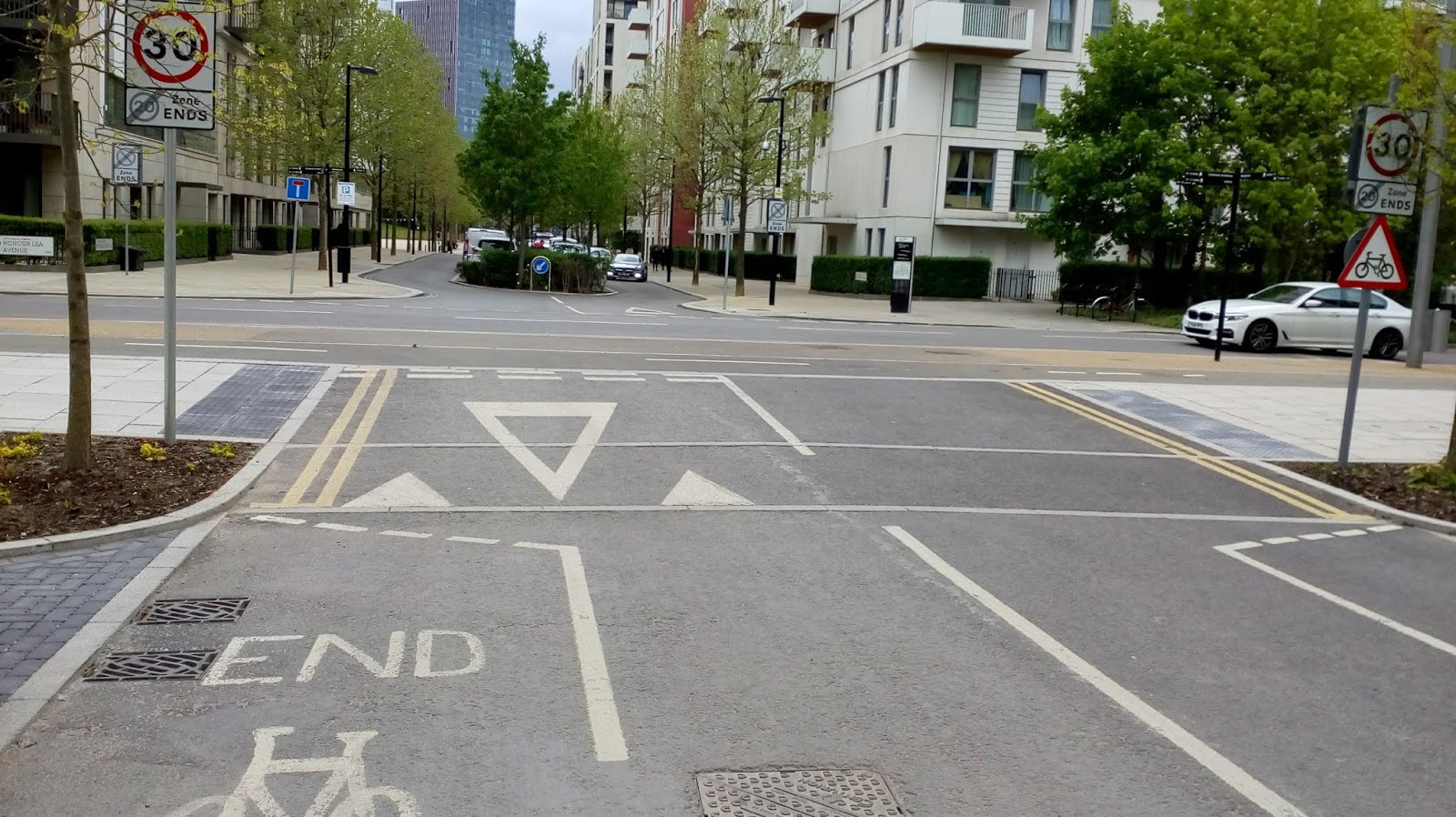
We are given a continuous cycle track across the entry to Peleton Avenue, although the geometry is too generous and signs have popped up to try and manage cyclist/ driver conflicts that the design invites.

A grid system of "main" streets running in one direction which cycle tracks (Honour Lea Avenue) with cross streets being made up of a series of looped cul-de-sacs (Scarlett Close) would actually create a very good neighbourhood. The current layout has some great features, but they don't quite join up and work properly which is a great shame. I'll leave you with a video;