Saturday, 30 November 2019

Ooh That's Low

A regular staple of local news is when a lorry is driven into a low bridge, despite it being plastered in signs and hi-viz stripes. So, what can be done about the problem?

The majority of bridge strikes (the term used) are on railway bridges simply because there are so many of them and with infrastructure going back decades and over 100 years, there's quite a legacy. We read news stories of bus drivers taking the roof off their vehicle because they were off route for some reason, or the notorious bridge which is forever being hit by HGV drivers.

Railways in the main are designed to be straight and flat because that's an efficient method of working and because so much of UK rail infrastructure predates mass motorisation, many roads have been bridged with headrooms reflective of the alignments of the time and in an era predating mass motorisation and the use of high vehicles. Whilst new railways still need to keep it flat and straight, the scope of the projects tend to ensure there is enough clearance if a road link is being maintained.

In the UK, any headroom under a non-arched bridge which is under 16' 6" or 5.03m should be signed on the structure accordingly using a regulatory traffic sign. Because the height is fixed, there is no requirement to back up the sign with a traffic regulation order and the use of the regulatory sign makes it easier to prosecute a disobedient driver;
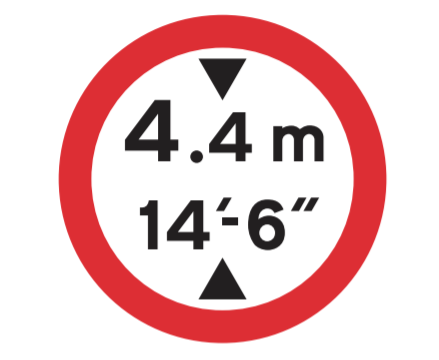

New signs should carry both imperial and metric measurements, although older imperial-only ones can stay until they are replaced. In addition, striped panels can be added to the bridge to help with conspicuity. The image below gives two options - the upper panel is designed to work with the regulatory sign in the centre and the lower panel if this doesn't work because of the bridge construction. The yellow stripes can be retroreflective and fluorescent.


For arched bridges, things are slightly different. Obviously, arched bridges are arched and so the headroom changes over the width of the portal and so while a vehicle might nominally fit in the centre, it might not to one side. Therefore warning signage is used;

Again we can add stripes and we should also use the white "chord" marking where the clear height is available over a width of not less than 3 metres. The chord marking should be retroreflective to show up at night in headlights. Of course, 3m is going to only allow single lane working of high vehicles and so thought is required as to how this will work.

It's not just bridge that needs signing. It's good practice to provide signage on the approaches and even better practice to sign low bridges well in advance with "escape" routes for the drivers of overheight vehicles. We can use height signs on advanced direction signage (with an alternative route if available);

We can use them on map type sign (which show the road layout ahead);


For arched bridges, there's a warning sign for the immediate approaches (a slightly annoying double sign to get imperial and metric);


We've also got some other signs which can be put on approaches or at key locations to help drivers avoid a low bridge (and we can add arrows and distance information);


So in terms of signage, there are lots of tools available to us, but of course, the main issue is people need to see them and act of the information. If signage were an answer, then we'd see no bridge strikes.

Modern technology might be able to help as shown in this short video from Cambridge University (this is the bridge);


Despite technology and lots of stripes, bridges still get hit such as this low example in Ely, Cambridgeshire which is the country's most hit bridge;


There are more radical engineering solutions which for me gives rise to three main options;
  • Close to motor traffic,
  • Implement a width restriction
  • Lower the road.
The cheapest solution would be to throw some bollards in and stop motor traffic to remove the risk completely and of course it has the added effect of dealing with through traffic volumes, but it's not a practical solution for some locations which are probably best for dealing with through traffic. A width restriction poses a similar problem, but at the network level it might be appropriate if the route doesn't need routine HGV access.

Lowering the road is an extremely expensive solution because of the likelihood of having to lower/ divert utilities, the potential to have to reinforce the bridge foundations and dealing with highway drainage where the dip is provided.

The other way to deal with it lies with changing how we transport our goods because a switch to smaller vehicles within cities will help reduce the risk of bridge strikes (although it isn't of course a wholly urban issue). There are also lower height lorries available which not only fit under low bridges (obviously depending on the location), they also have direct vision cabs which is safer for people outside of the vehicles;


Whatever solutions are appropriate, I can't see the problem of bridge strikes being solved any time soon and in the big scheme of things it's not a huge cost, some £23m a year in repairs according to Network Rail and although they aim to recover the full cost of repairs, it doesn't take into account the losses highway and rail users incur through being delayed and disrupted.

Saturday, 23 November 2019

Overreached

Hands up who has heard of the Dutch Reach? Well I've heard about it because I'm writing about it, but even for me it's a relatively new concept.

The Dutch Reach is apparently the way that Dutch drivers are taught to open their car doors so they don't open it into a person cycling. The thing which apparently makes it uniquely Dutch is they open the door with their hand that's furthest away from the door because the movement. Except, if the anecdotes of Twitter are to be believed, it's a sporadic movement at best. I tagged the idea with my Twitter Bullshit Klaxon which I appreciate is not subtle and not conducive to a polite discussion, but you sometimes need to tell the Emperor that you can see his nuts.

As someone pointed out on Twitter, the English don't refer to English muffins as English muffins. So why does this idea keep doing the rounds? As a person who occasionally drives and who passed their test in 1991 I have always checked what's going on around the car when getting out even as a passenger - first using the wing mirror, then checking over my shoulder and then as I open the door - a little at first.

My driving instructor taught me lots of little tricks such as filling up with petrol on the "wrong" side of the car before hoses were quite as long as they are now and when changing lanes, checking my shoulder just in case.

It turns out the resurgence of the technique is because the AA and BSM (owned by the AA) are apparently teaching it and it made some of the newspapers and trade press in the week and 62% of British drivers haven't heard of it (and it's been long picked up by some cycling campaigns). Of course, if I hadn't seen it on social media, then I wouldn't be writing this post and besides, what have I got against the Dutch Reach?

Well, if it helps you not to door a person cycling then be my guest, but it's not some amazing behavioural fix because even though it's a specific motoring offence, plenty of people are getting hurt and this is the problem with behavioural campaigns - it's going to take one hell of an effort to get the message out to the 62% of drivers who haven't heard of the Dutch Reach!

Somewhat ironically, we also learned (I had missed the March announcement) that despite the fifth anniversary of the AA's "Think Bikes" campaign that "more drivers are surprised by a cyclist or motorcyclist apparently ‘appearing from nowhere’ than they were five years ago".

Perhaps we need to actually face up to the reality of all this because drivers (and sometimes passengers) are pretty poor at seeing people cycling (and let's face it, people walking). There is lots of incompetence out there, there's lots of rule breaking and let's be honest, people are not very good regardless of their chosen transport mode.

This is why personally, I advocate for design-led solutions to road danger which anticipate that humans are fallible and that mistakes will be made (and this could be by anyone). Mistakes on our streets should not be a death sentence and frankly, we can educate and enforce until we are blue in the face, it is never going to be enough. So, dear reader, if you want to import sometime Dutch to keep people safe, then import "Sustainable safety" because it's the only thing which keeps people safe 24 hours a day and all year round. Of course for the Dutch, this all remains a constant work in progress.

Cycle track with a buffer from car parking to
reduce the dooring risk.

Saturday, 16 November 2019

CD195 Designing For Cycle Traffic

A couple of weeks back I wrote about how the Design Manual for Roads & Bridges (DMRB) was changing and this week I'm doing to have a dig through CD195 - Designing for Cycle Traffic.

The first thing to say is the DMRB is a standard to be used on Highways England and devolved administration schemes. It is a useful document for trunk road style roads and caution should be exercised when using it for local roads and streets because much of the information is not applicable.

That stated, CD195 has plenty of general application within its pages because the physical space, design speed and user requirements for cycle traffic apply everywhere. It's also an important point that the term "cycle traffic" is being used because we are dealing with a distinct mode of transport which is not motor traffic and it is not walking traffic. As Professor John Parkin says, "cycles are vehicles capable of speed"!

In terms of overall layout, there is a brief initial section for matters which all apply to Highways England, Transport Scotland, the Welsh Government and the Department for Infrastructure. The document then splits into four annexes, one for each for each of the four administrations. 

For England, the national annexe is a set of detailed information for the design of cycling infrastructure on the Highways England network. The annexes for the other three administrations are extremely short with only a couple of clauses each. The key ones are;

NI/1.1 Direction on the design of routes and facilities for cycle traffic in Northern Ireland shall be obtained from the Department of Infrastructure.

S/1.1 The design of routes and facilities for cycle traffic in Scotland shall be in accordance with Cycling by Design.


W/1.1 The design of routes and facilities for cycle traffic in Wales shall be in accordance with Active Travel (Wales) Act 2013 Design Guidance.

So in practice, the bulk of CD195 only applies to the English annexe and the three other administrations use their own guidance which in my view is a problem because of the age of the Scottish and Welsh documents and the absence of anything for Northern Ireland (at least to the best of my knowledge).

In the first part of the UK-wide introduction, we are reminded that the scope of CD195 is for the "design of routes and assets used by cycle traffic" - it's not for shared paths and this is an immediate problem where the default design choice is for shared designs. I'm hoping that in due course there will be better direction in this matter (which will sit elsewhere) because in many cases, there's nothing wrong with sharing if pedestrian traffic is very low and cycle traffic low to moderate.


The photo above is a cycle track on the Danish North Sea island of Fanø. I was the only person walking here and cycle traffic was low. Of course in rural areas there may be walking connections to local services and bus stops for example and in that situation, I'd expect the design to change for a section. For me, this is an issue that needs dealing with, especially as the DMRB standards on sharing are yet to be updated.

The second part of the UK-wide introduction simply refers the reader to other parts of the DMRB which should be read in conjunction with the text. In this case, just one reference to the introduction to DMRB.

So, to the English Annexe, which is set out under the following headings;
  • Foreword
  • Introduction
  • Abbreviations
  • Terms and definitions
  • Types of cycle route
  • Cycle design vehicle
  • Cycle route design
  • Crossings
  • Junctions
  • Signing
  • Normative references
  • Informative references
  • Appendix E/A - One-way and two-way cycle tracks
The introduction repeats the point that the standard is for routes used only by cycle traffic because of higher design speeds (notwithstanding my comments above). The abbreviations and terms/ definitions are helpful to get tuned into the language.

The types of cycle route are a couple of tables. The first looks at the minimum provision for traffic speeds and flows;


The second looks at the five conditions for good cycling infrastructure which will be familiar to students of the Dutch experience;


The cycle design vehicle section recognises that there are many types of cycle and many types of people using them. A "Cycle Design Vehicle" (CDV) of 2.3m in length by 1.2m in width is given to cover most situations;


Frankly, most designers could do with looking that the first two tables and the cycle design vehicle diagram! The point about the CDV is that people need space within which to cycle in terms of forward movement, curves and corners; this idea flows through the annexe.

The section on cycle route design is concerned with the different types of provision given the traffic conditions (lanes, tracks, protection etc) and it recognises that effective widths of provision are eroded by high kerbs, vertical features and gullies. There is advice on visibility, gradients, transitions between types of provision and dealing with bus stops (which should have cycle bypasses). The section contains all of the physical information one could need - a good point is made that two-way cycle tracks should have a centre line to enable people understand that they are two-way.

Because of the CDV and the need to make our infrastructure accessible, we are also treated with this group of clauses which I fully endorse!

E/3.32 Cycle tracks shall be clear of street furniture and obstructions with the exception of features to prevent motor traffic access.

E/3.33 The gap between posts and other physical constraints on cycle tracks shall be a minimum of 1.5 metres to restrict access by motor traffic while retaining access by cycle traffic.

E/3.34 Bollards on cycle tracks shall be aligned in such a way that enables a cycle design vehicle to approach and pass through the bollards in a straight alignment.

E/3.35 A frame and K frame type barriers, often used to prevent motorcycle access, shall not be used on cycle tracks.

Within the section on crossings, there is a large table which sets out the traffic conditions which lead to each type of crossing. For uncontrolled situations, we should not be expecting people to cross multiple traffic lanes. For higher speed roads, the inescapable conclusion is people need either signals to cross or grade separation (the latter where flows and speeds are at the higher end).

One issue I do have an issue with is where cycle tracks are running adjacent to the carriageway or bent-in (from a position away from the road to being adjacent) and the designer is invited to return cycle traffic to carriageway level within a lane before the junction in order to ensure people cycling are in a position which makes them visible.


The document is aimed at trunk road and motorway schemes and so inevitably, this will lead to changes on local roads as part of interface or legacy works. Although this is only for 30mph and lower situations, this type of layout is a cop-out because project sponsors need to work harder to ensure enough land is provided for decent layouts. 

Junctions are treated to detailed advice with emphasis on roundabouts. We're reminded that we should not put cycle lanes on the perimeter of roundabouts because it's dangerous. For compact roundabouts (essentially smaller roundabouts with single lane entries and exits) with more than 8,000 vehicles a day, cycle traffic should be taken around on cycle tracks. I don't think daily traffic flow is a detailed enough metric because in situations with heavy peak flows and very quiet off-peaks, it's still going to be awful to mix with traffic.


The photo above is a standard Dutch compact roundabout with a two-way cycle track, set back crossing points (about 10m), tight vehicle geometry (including HGV overrun around the centre). We can safely copy this approach, yet we don't and nonsense like this layout in Cambridgeshire keeps getting built;


Larger roundabouts (known as normal roundabouts) have a variety of solutions for cycling;
  • provide cycle tracks around the junction, with cycle track crossings of each arm;
  • remodel the junction as a compact roundabout, where permitted by CD 116;
  • provide grade separated cycle tracks around and/or across the junction;
  • introduce signal control to the roundabout, with appropriate cycle track provision;
  • replace the roundabout with a signal controlled junction or another form of junction, with appropriate cycle track provision.
Of course, when crossing each arm, we refer back to the section on crossings and we'll realise that once we have multi-lane approaches/ exits, high speed limits and higher flows we're into signals or grade separation! CD116 is for roundabout design which is a separate blog post in its own right!

The section on signing is mainly about directional signing strategy (so people can follow a decent route to where they are going to) and how the signage should be laid out. After the references, the table on one-way and two-way cycle tracks is useful to explain the advantages and disadvantages of the approaches.

So, there you have it, a blast around the new standard. Frankly, if every designer of trunk road style schemes started using this tomorrow, we'd see a big improvement and actually, there application in suburban areas too. 

The standard is based on an earlier interim advice note which was published in 2016 and so there will be people out there wondering why crap is still being built. It's a two-fold problem. For Highways England schemes, there are various stages where processes are fixed and one of them is on which standards are being used. With many current schemes, the standards fix predates 2016. 

The second issues is one of project scope. While CD195 will be used on new schemes, it's important that issues are brought into project scope in the first place and in my opinion, this also includes matters of historic severance. This is an issue to be tackled away from design standards and will no doubt need political weight brought to bear.

Saturday, 9 November 2019

Traffic Signal Pie: Automatic For The People

This post is part of an occasional series on traffic signals. This time, I'm discussing push buttons at crossings.

We all know about push buttons at crossings (stand alone or at junctions). They are there to register a demand from people who wish to cross the road;


They are the familiar boxes with the yellow shells (see a toucan crossing above) either attached to the traffic signal post or as a separate post. You also see them as slightly smaller boxes where a second push button is provided such as this chilly example;


There are various push button layouts for various situations;


There are two things to accept when we talk about people having to push a button to register their demand to proceed;
  • Traffic signals are there to manage motorised traffic.
  • The ultimate decision on highway space is political.
So, we end up with the simple act of wanting to cross the road being bumped down the pecking order by both traffic and politics. because we've seen the car as freedom and the politics supported this leaving it harder to cross the road in some places.

Detection for general traffic is pretty much universal using sensors in the road and on the traffic signals. It can be very clever counting vehicles through junctions and the control computers can adapt on the fly. Cycle traffic gets a bit of this where dedicated space is provided, although push buttons are still common.

People on foot (and I include those using wheeled mobility aids) get the raw deal because they have to press a button. Because of the way we configure space and that push buttons are mainly on poles near the kerb, we often make it hard or impossible for some people to press the button. In this film, Esther shows us that poor positioning of push buttons at this crossing makes it impossible for her to reach the button when using her wheelchair;


The problem here is the layout of the island with the push button on a post behind a kerb, so she cannot get close enough to press and so this could potentially be solved with some works, but is does show how easy it is to install something which is useless for many people.

It's also a problem for users of non-standard cycles where the push button cannot be reached without sticking the front of the cycle into the road or for hand cyclists and recumbent users, they are also seated lower down;


The above photo is a little bit of fun, but from my seated position, there is no way I could reach the button and unlike me, there are people who cannot easily dismount or dismount at all.

At multi-stage crossings where there is only one direction people are going to leave the central island (like where Esther was crossing), I think that the signal push buttons should be linked. There is no technical reason why pushing a button cannot register demand at the right time from the island.

Elsewhere, we have to think about how we can avoid people having to push a button at all. It would be possibly to run signals on a timer so the green man (and/ or bike) comes in every so often, but people should be able to turn up and cross and like drivers, we need detection.

I have never seen one myself, but pressure mats have been used in the UK to register someone waiting to cross - there is a report from the early 1990s on the testing of puffin crossings, although this was more about detecting that someone had walked off so the demand could be cancelled. The problem with this technology is that having stuff recessed into the ground puts it at risk from water and failure.

Modern crossings now use clever detection to sense people standing at a crossing using infrared or video with artificial intelligence tracking people through a space. There are companies looking at technology and in London, a pedestrian version of SCOOT is being tested which can extend green times where there are more people wanting to cross.

In time, we should see detection taking over from the need to push a button. I don't know if we'll see the end of the push button completely, but it would be nice to see new displays appearing which can reassure people that they have been "seen" and even better, how long they have until they get to cross (like many other countries manage). Eventually, we need more places were we get rid of traffic to the point where we need far fewer traffic signals, but that's another story!

This post is part of an occasional series on traffic signals - for more posts, search "Traffic Signal Pie" in the search bar or click here.

Saturday, 2 November 2019

Dem Bones, Dem Bones...

Well a tenuous link to Halloween I guess, but this week, I'm looking at the 'dog bone' roundabout which is a bit of a curiosity.

The dog bone junction is a development of the dumbbell junction which is a grade separated (roads on different levels) arrangement consisting of a pair of roundabouts connected by a short road which goes above or below a main road with slip roads connecting the roundabout to the main road, like this junction on the A13 in East London;


The reason for the layout is to keep the high-speed main road flowing without delays and safety risks by having junctions at grade (on the same level). The photo below is a view of this type of junction where the main road is carried on a flyover with the roundabouts and local roads below. The arrangement can be reversed with the main road at a lower level.


The layout means that there's less road and structures work than might be the case with a larger junction such as a single roundabout under or over the main road. The example above is slightly unusual because of the length of the main road bridge, but local levels mean it's on a long viaduct. Here's a schematic of the local roads over the main road.

The problem with the arrangement comes when we want to take people walking and cycling across the junction because we are going to have to get people over the slip roads. In my example from the A13, I've sketched the shared walking and cycling routes which run through the junction in red;


This junction isn't too bad as the slip roads have toucan crossings, the usual UK problem though is that they take ages to get a green man/ cycle and so people tend to chance a gap in the traffic to get across.

If you look closely at the aerial images of the roundabouts, you'll notice the marks on the road from vehicle tyres which show the heaviest movements, highlighted here;


Clearly there are very few movements all the way round the roundabouts - in other words, people coming along the local roads, performing a U-turn at a roundabout and going back the same way - this gives a hint of how the dog bone roundabout works.

At the next junction to the west, this little-used area has been filled in (to form two "tear drops") and the roundabout is now one loop - welcome to the dog bone roundabout!


The junction was signalised and converted into a dog bone roundabout in order to provide a cycle route around it and to increase the junction capacity (because the arrangement gives more stacking space). It's arranged so that drivers getting into the correct lane at the approach will pop out at the correct exit. The cycle route taken over the slip roads and the access to the business park from the northern roundabout by toucan crossings again;


It's OK to cycle through , but the stop start of toucan crossings does make it hard work sometimes, although at peak time, there's no way you can find a gap in traffic.

So far, I've given some urban/ industrial area examples. There is a debate on whether we should be building urban roads like this at all, but if the infrastructure is already there, some retrofitting is more likely than a rebuild and of course, signalising gives a great opportunity for walking and cycling space. 

In theory one could take the walking and cycling route through the centre of the junction as shown below;


In this example, those not needing to access the industrial estate bypass the toucan so it's a bit more efficient and there's no dog-leg on the slip road crossings. However, the signalling needs careful thought in terms of where stop lines go for general traffic. 

Where the idea comes into its own is when we can grade separate the walking and cycling route and that is going to be on the edge of town or interurban locations where signals are less favoured; with the increasing use of "free flow" slip roads (known as Segregated Left Turn Lanes - SLTLs) it's even harder to get people through the junctions on foot and cycle (and I'll cover SLTLs in another post soon).

For junctions which are being changed to a dumbbell arrangement being added, I think they should be developed as dog bone layouts with grade separation for walking and cycling, assuming walking and cycling cannot be completely unbundled (and in many cases, the local roads are the desire line). The drawing below has the main road at a lower level than the local roads;


In this arrangement, the walking and cycling route (red) runs alongside the local roads and crosses into the centre of the tear drops before crossing over the main road in the centre of the bridge which carries the central road. This bypasses the slip roads completely and maintains a good desire line. Here's a variation with an SLTL on one quadrant of the junction which shows the scalability of the layout;


Grade separation means that drivers and people walking/ cycling are not held up when using the arrangement, but the key to the layout is the dog bone arrangement couple with taking the walking and cycling route through the centre of the junction - it might be a little less comfortable between traffic lanes passing either side, but with some offset for vehicle restraint barriers, I'd argue the loss of comfort it exceeded by the improvement in directness.